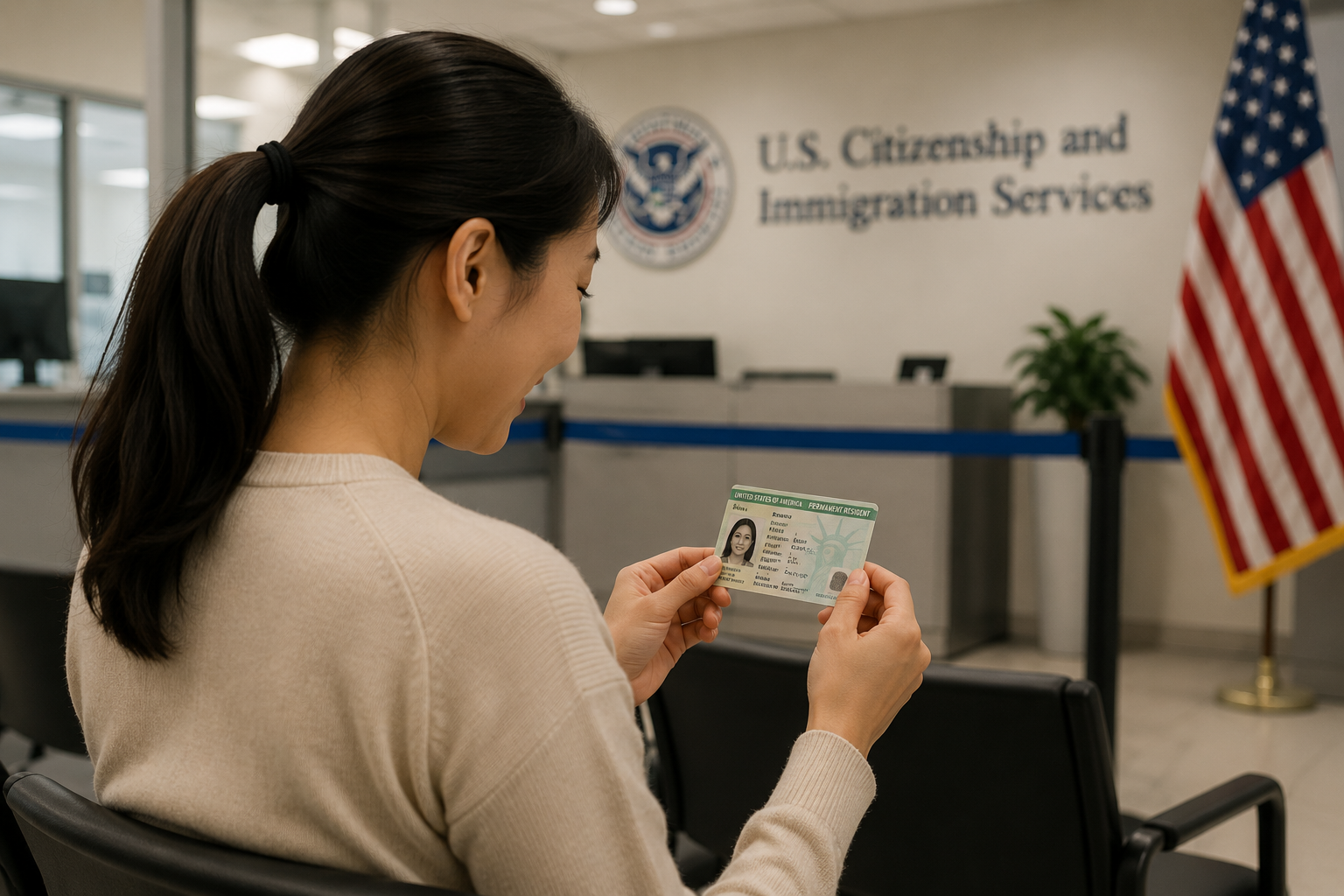
Applying for a Green Card while in the United States is possible for some people. This process is usually called adjustment of status.
In simple terms, adjustment of status means asking USCIS to change your immigration status to lawful permanent resident without leaving the United States. USCIS explains that Form I-485 is used to apply for lawful permanent resident status if you are in the United States.
However, not everyone who is inside the United States can apply this way. Your eligibility depends on your immigration category, your current situation, how you entered the United States, whether a visa number is available, and other factors.
This article gives a simple overview for first-time immigration readers. It is general information only and not legal advice.
What Does It Mean to Apply for a Green Card Inside the United States?
When people talk about applying for a Green Card inside the United States, they usually mean filing Form I-485, Application to Register Permanent Residence or Adjust Status.
This is different from applying for an immigrant visa at a U.S. embassy or consulate outside the United States.
There are usually two main paths:
- Adjustment of status
You apply for a Green Card while physically present in the United States. - Consular processing
You apply for an immigrant visa through a U.S. embassy or consulate outside the United States.
USCIS describes adjustment of status as the process used to apply for lawful permanent resident status, also known as applying for a Green Card, while in the United States.
Who May Be Able to Apply for a Green Card While in the United States?
You may be able to apply for a Green Card in the United States if you qualify under an eligible immigration category.
Common categories may include:
- Family-based Green Cards
- Marriage-based Green Cards
- Employment-based Green Cards
- Certain humanitarian categories
- Certain special immigrant categories
- Some refugee or asylee situations
- Other categories listed by USCIS
USCIS states that a person must be eligible under one of the Green Card categories before applying.
For example, some immediate relatives of U.S. citizens may be able to apply from inside the United States if they meet the requirements. Immediate relatives generally include a spouse of a U.S. citizen, an unmarried child under 21 of a U.S. citizen, or a parent of a U.S. citizen who is at least 21 years old. USCIS has a specific page for immediate relatives in the United States who want to apply for permanent resident status.
What Is Form I-485?
Form I-485 is the main application used for adjustment of status.
If you are applying for a Green Card inside the United States, Form I-485 is usually the form that asks USCIS to approve your permanent resident status.
Depending on your category, you may also need other forms or documents, such as:
- A family petition, such as Form I-130
- An employment petition, such as Form I-140
- A medical exam form
- Proof of identity
- Proof of lawful entry, if required
- Passport-style photos
- Filing fee or fee waiver request, if available
- Evidence for your specific Green Card category
The exact documents depend on your case. Always check the current USCIS instructions before filing.
Can You File the Petition and Green Card Application Together?
In some cases, yes.
This is called concurrent filing. It means the immigrant petition and Form I-485 are filed at the same time.
For example, some family-based applicants may be able to file Form I-130 and Form I-485 together. Some employment-based applicants may also be able to file certain forms together if a visa number is available.
USCIS explains that concurrent filing is available only for an applicant who is physically present in the United States and requesting to adjust status to lawful permanent resident.
However, concurrent filing is not available for everyone. Some applicants must wait until the petition is approved or until a visa number becomes available.
What Does “Visa Number Available” Mean?
For many Green Card categories, an immigrant visa number must be available before a person can file Form I-485.
This is especially important for many family preference and employment-based categories.
Some categories have waiting lines. The wait can depend on:
- The type of petition
- The applicant’s country of birth
- The priority date
- The monthly Visa Bulletin
- The immigration category
Immediate relatives of U.S. citizens usually do not have the same visa number waiting line, but they still must meet all eligibility requirements.
Because this area can be confusing, applicants should carefully review USCIS instructions and the Department of State Visa Bulletin when needed.
Basic Steps to Apply for a Green Card While in the United States
The process can vary, but many adjustment of status cases follow these general steps.
Step 1: Confirm Your Green Card Category
First, you need to know which Green Card category applies to you.
For example:
- Are you applying through a U.S. citizen spouse?
- Are you applying through another family member?
- Are you applying through an employer?
- Are you applying through asylum, refugee status, or another category?
Each category has different rules.
Step 2: Check Whether You Can Adjust Status
Being physically present in the United States does not automatically mean you can apply for adjustment of status.
USCIS may look at issues such as:
- How you entered the United States
- Your current immigration status
- Whether you have maintained status, if required
- Whether you have immigration violations
- Whether a visa number is available
- Whether you are subject to any grounds of inadmissibility
Some situations may require legal advice before filing.
Step 3: Prepare Form I-485 and Supporting Documents
After confirming eligibility, the applicant prepares Form I-485 and the required evidence.
If you are organizing your immigration documents for the first time, you may also want to review a U.S. visa application checklist to understand common document preparation steps.
Common documents may include:
Step 4: File the Application With USCIS
The application must be sent to the correct USCIS filing location. Filing addresses can change, so applicants should always check the official USCIS page before mailing anything.
Applicants should also check the current filing fee. Fees can change, and the correct amount depends on the form and situation.
Step 5: Attend Biometrics Appointment
After filing, USCIS may schedule a biometrics appointment.
At this appointment, USCIS usually collects fingerprints, a photo, and a signature.
Step 6: Respond to USCIS Requests if Needed
Sometimes USCIS sends a Request for Evidence, often called an RFE.
An RFE means USCIS needs more information before making a decision. It does not always mean the case will be denied.
It is important to answer by the deadline and provide the requested documents.
Step 7: Attend an Interview if Required
Some Green Card applicants must attend an interview.
At the interview, a USCIS officer may ask questions about the application, eligibility category, immigration history, and supporting documents.
Marriage-based applicants may be asked questions about the relationship.
Step 8: Wait for the Decision
USCIS may approve, deny, or request more information.
If approved, the applicant becomes a lawful permanent resident and later receives a Green Card.
If denied, the notice should explain the reason and whether any options may be available. In that situation, it may be helpful to speak with a qualified immigration attorney.
Can You Work While Waiting for a Green Card?
Filing Form I-485 does not automatically mean you can work.
Many adjustment applicants apply for a work permit using Form I-765. If approved, they receive an Employment Authorization Document, often called an EAD.
You should not start working unless you are already authorized to work or you receive proper work authorization.
Can You Travel While Waiting for a Green Card?
Travel can be risky while Form I-485 is pending.
Some applicants apply for advance parole using Form I-131 before traveling outside the United States. However, leaving the country without proper permission can cause serious problems for some applicants.
Before traveling, applicants should carefully review USCIS instructions or speak with a qualified immigration attorney if the situation is complicated.
Common Mistakes First-Time Applicants Should Avoid
Many Green Card problems happen because of simple mistakes.
If you are worried about possible problems in your immigration history, it may also help to review common U.S. visa rejection reasons so you can understand what officers often look at in visa-related decisions.
Common mistakes include:
- Filing Form I-485 before being eligible
- Using the wrong filing address
- Paying the wrong filing fee
- Forgetting required documents
- Sending incomplete forms
- Not signing the form
- Ignoring USCIS notices
- Missing biometrics or interview appointments
- Traveling without understanding the risks
- Assuming every person inside the United States can adjust status
A Green Card application is important. It is better to review everything carefully before filing.
If you are worried about possible problems in your immigration history, it may also help to review common U.S. visa rejection reasons so you can understand what officers often look at in visa-related decisions.
What If You Entered the United States Without a Visa?
This is a more complicated situation.
Some people who entered the United States without inspection may not be able to adjust status in the normal way. However, there may be exceptions or special rules depending on the person’s history, family situation, old petitions, humanitarian status, or other factors.
Because this area can be serious, people in this situation should not guess. They should review official instructions and consider speaking with a qualified immigration attorney.
What If You Overstayed Your Visa?
A visa overstay can affect eligibility, but the result depends on the case.
For example, some immediate relatives of U.S. citizens may still be able to apply for adjustment of status in certain situations. Other applicants may face more serious problems.
The details matter. The type of visa, the length of overstay, the Green Card category, and other immigration history can all be important.
Is Applying Inside the United States Always Better?
Not always.
Adjustment of status can be convenient because the applicant may not need to leave the United States. But it is not always available, and it is not always the best option.
Some people must use consular processing. Others may choose consular processing depending on their situation.
Before deciding, applicants should understand the benefits, risks, timing, travel issues, and eligibility rules.
FAQ: Applying for a Green Card While in the United States
Can I apply for a Green Card while visiting the United States?
It depends. Being in the United States as a visitor does not automatically make you eligible to apply for a Green Card. Your intent, timing, immigration category, and eligibility all matter. This can be sensitive, so you should review official guidance or get legal help if needed.
Do I need to be married to a U.S. citizen to apply inside the United States?
No. Marriage to a U.S. citizen is only one possible category. Some people apply through employment, other family relationships, asylum, refugee status, or other categories.
Can I stay in the United States while Form I-485 is pending?
Many adjustment applicants remain in the United States while Form I-485 is pending, but each case is different. Applicants should understand their status, pending application, work authorization, and travel limits.
How long does adjustment of status take?
Processing times can change. The time depends on the category, USCIS workload, the local office, background checks, missing documents, and whether an interview or RFE is required. Always check current USCIS processing time information.
Does filing Form I-485 guarantee approval?
No. Filing an application does not guarantee approval. USCIS must review eligibility, documents, background checks, and any possible inadmissibility issues.
Final Reminder
You may be able to apply for a Green Card while in the United States through adjustment of status, but only if you meet the requirements.
The most important questions are:
- What Green Card category applies to you?
- Are you eligible to adjust status?
- Is a visa number available, if required?
- Do you have the correct forms and documents?
- Are there any immigration history issues that could affect your case?
For simple cases, the process may feel manageable with careful preparation. For complicated cases, it is usually better to get help from a qualified immigration attorney before filing.