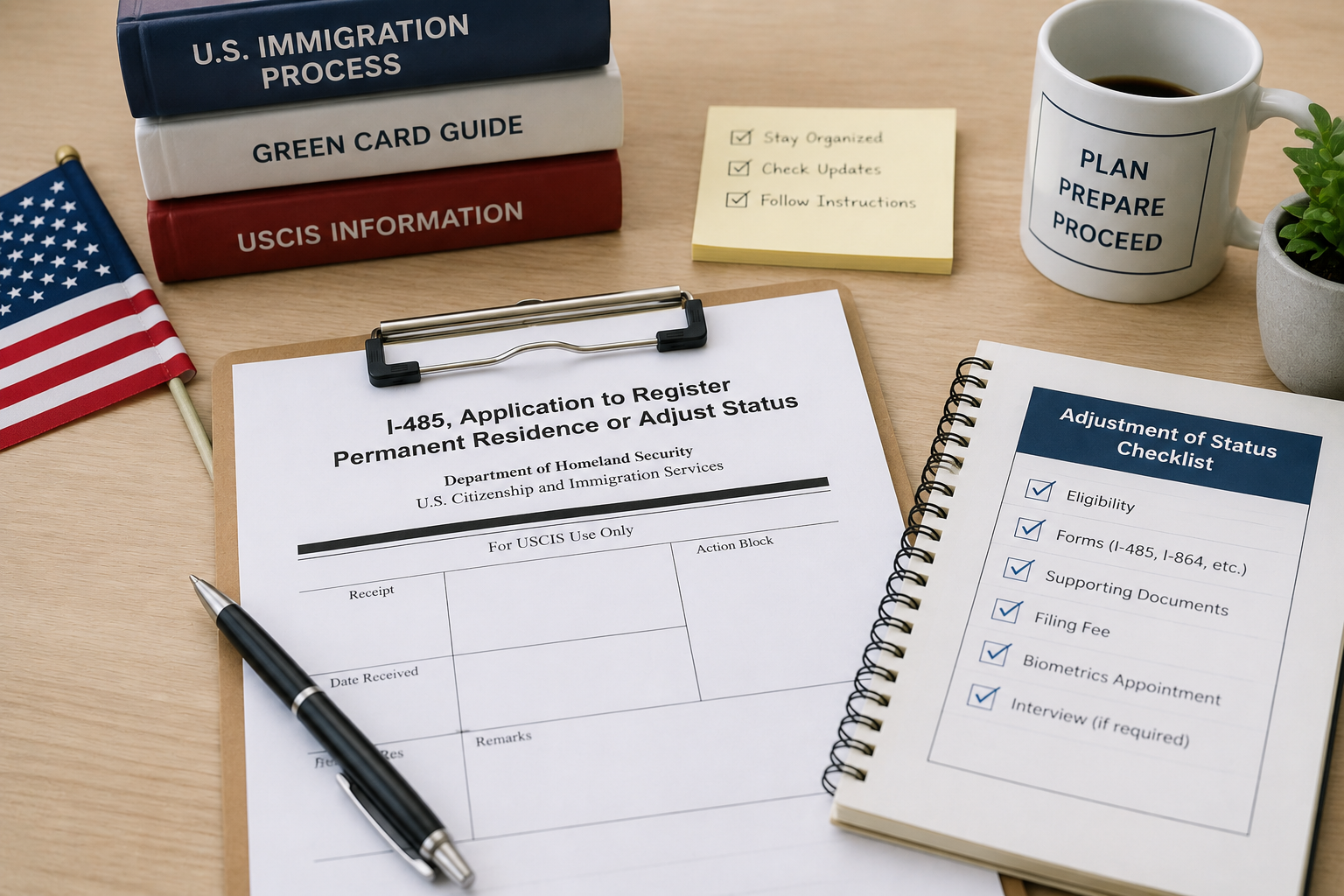
Applying for a green card from inside the United States can feel confusing, especially if you are hearing the term “adjustment of status” for the first time.
Adjustment of status is the process that allows some people already in the U.S. to apply for lawful permanent residence without leaving the country for an immigrant visa interview abroad. The main form used for this process is usually Form I-485, Application to Register Permanent Residence or Adjust Status.
This process is not available to everyone. Your eligibility depends on your immigration category, how you entered the United States, your current situation, visa availability, and other case details.
What Does Adjustment of Status Mean?
Adjustment of status means applying for a green card while you are physically present in the United States.
For example, someone may become eligible for a green card through a U.S. citizen spouse, a family petition, an employment-based petition, asylum status, or another qualifying immigration category.
If the person is eligible, they may be able to file Form I-485 with USCIS instead of leaving the United States to complete the process at a U.S. embassy or consulate.
Who Can Apply for Adjustment of Status?
There is no single answer that applies to every person. In general, an applicant usually needs a valid immigration basis and must meet the requirements for their green card category.
Some common adjustment of status categories include:
- Family-based green card applicants
- Marriage-based green card applicants
- Employment-based green card applicants
- Certain asylum or refugee-based applicants
- Certain special immigrant categories
Being inside the United States does not automatically mean you can adjust status. Some people may be barred from adjustment because of immigration violations, unlawful presence issues, certain entries without inspection, criminal history, or other problems.
If your case has any complicated history, it is a good idea to speak with a qualified immigration attorney before filing.
Adjustment of Status vs. Consular Processing
Adjustment of status and consular processing are two different ways to complete the green card process.
Adjustment of status usually happens inside the United States through USCIS. Consular processing usually happens outside the United States through a U.S. embassy or consulate.
For many applicants, the right path depends on where they are located, how they entered the U.S., their immigration history, and their green card category.
For example, a person already in the U.S. may still need to use consular processing if they are not eligible to adjust status. On the other hand, a person who is eligible and already in the U.S. may be able to file Form I-485 without leaving the country.
Why Visa Availability Matters
Some green card categories have yearly limits. This means a person may need to wait until an immigrant visa is available before filing Form I-485.
This is especially important in many family preference and employment-based categories. Applicants may need to check the Visa Bulletin and USCIS guidance to see whether they can file.
Immediate relatives of U.S. citizens, such as spouses, unmarried children under 21, and parents of U.S. citizens who are at least 21 years old, are treated differently from many preference categories because immigrant visas are generally immediately available for them.
If you are not sure whether your category is current, do not guess. Check the current USCIS filing chart guidance before sending your application.
Basic Steps in the Adjustment of Status Process
The exact steps depend on the type of case, but many adjustment of status cases follow a similar path.
First, the applicant needs a qualifying basis for a green card. In a family case, this may involve Form I-130. In an employment case, this may involve Form I-140.
Next, the applicant checks whether Form I-485 can be filed. Some people can file the petition and Form I-485 together. Others must wait until a petition is approved or until a visa becomes available.
After filing, USCIS usually sends a receipt notice. The applicant may also receive a biometrics appointment notice for fingerprints, photo, and signature.
USCIS may later ask for more evidence, schedule an interview, or continue reviewing the case based on the documents already submitted.
If the case is approved, the applicant becomes a lawful permanent resident.
Documents You May Need for Form I-485
The documents depend on the type of green card case. However, many applicants may need items such as:
- A copy of a passport biographic page
- A copy of a visa page, if available
- A copy of the I-94 travel record, if required
- Birth certificate
- Certified English translation for non-English documents
- Passport-style photos
- Medical exam documents from a USCIS-designated civil surgeon
- Proof of the underlying petition or eligibility category
- Financial support documents, if required
- Marriage certificate or family relationship documents, if applicable
This list is only general. USCIS instructions can change, and each category may have different requirements. Before filing, always review the latest Form I-485 instructions for your specific situation.
Can You Work While Form I-485 Is Pending?
Filing Form I-485 does not automatically mean you can work.
Many adjustment of status applicants also file Form I-765 to request employment authorization. If approved, USCIS issues an Employment Authorization Document, often called an EAD.
Until you have valid work authorization, you should be careful about working in the United States. Unauthorized employment can create problems in some immigration cases.
Can You Travel While Form I-485 Is Pending?
Travel during a pending adjustment of status case can be risky.
Some applicants apply for advance parole before leaving the United States. Advance parole may allow certain applicants to return while their Form I-485 is pending.
However, travel rules can be complicated. Leaving the U.S. without the proper document may cause USCIS to treat the Form I-485 as abandoned in some cases. Travel can also create other immigration issues depending on your history.
Before traveling, check the official instructions and consider speaking with a qualified immigration attorney if your case is not simple.
Common Mistakes to Avoid
Adjustment of status is a major immigration step, so small mistakes can lead to delays or problems.
Common mistakes include filing too early, using an outdated form, missing required documents, forgetting translations, ignoring USCIS notices, missing a biometrics appointment, or traveling without understanding the risk.
Another common mistake is assuming that everyone who entered the United States with a visa can automatically adjust status. Eligibility depends on the full case, not just physical presence in the U.S.
It is also important not to rely only on advice from friends, online comments, or old information. Immigration forms, fees, and filing rules can change.
How Long Does Adjustment of Status Take?
Processing time depends on the case type, USCIS workload, local field office, background checks, interview requirements, and whether USCIS asks for more evidence.
Some cases may move faster than others. A simple family-based case may not follow the same timeline as an employment-based or special category case.
The safest approach is to check the USCIS case status tool and current processing time information for your form and office. Avoid making major plans based only on someone else’s timeline.
Adjustment of Status FAQ
Is adjustment of status the same as getting a green card?
Adjustment of status is the process of applying for a green card from inside the United States. If USCIS approves the application, the person becomes a lawful permanent resident.
What form is used for adjustment of status?
The main form is usually Form I-485, Application to Register Permanent Residence or Adjust Status.
Can I file Form I-485 if I am in the United States?
Not always. You must be eligible under a qualifying immigration category and meet the requirements for adjustment of status.
Do I need to leave the U.S. for an interview?
If you are eligible for adjustment of status, the process usually happens inside the United States. Some applicants may have an interview at a USCIS office. This is different from consular processing abroad.
Can I work while my green card application is pending?
You may be able to apply for work authorization, but Form I-485 alone does not always give you permission to work. Many applicants file Form I-765 and wait for the EAD approval.
Should I use a lawyer?
Some people file on their own, but legal help may be important if you have unlawful presence, a prior denial, criminal history, removal proceedings, entry without inspection, fraud concerns, or other complicated facts.
Before filing Form I-485, make sure you understand your eligibility, your visa category, and the documents required for your case. Adjustment of status can be a helpful path to a green card, but filing the wrong way or too early can create delays or serious problems. Always check the latest USCIS instructions before applying.
This article is for general information only and is not legal advice.