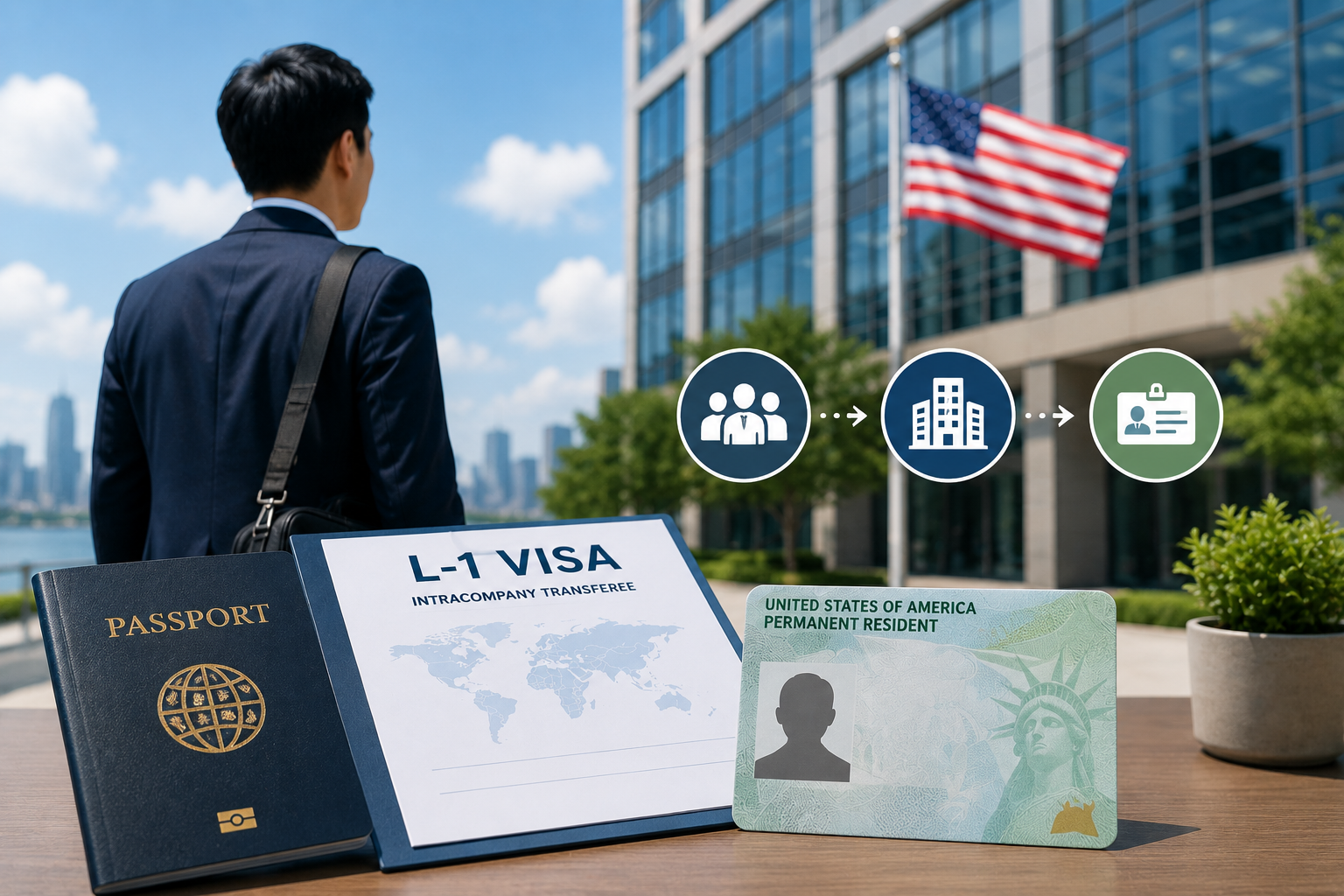
Many people who enter the United States on an L-1 visa later ask the same question: Can I apply for a green card after entering the U.S. on an L-1 visa?
In general, the answer is yes, an L-1 visa holder may be able to apply for a green card, depending on the person’s job, employer, immigration history, and green card category. An L-1 visa is a temporary work visa, but it can sometimes lead to an employment-based green card process.
The path is not the same for everyone. A person with an L-1A visa may have a different green card option than a person with an L-1B visa.
What Is an L-1 Visa?
The L-1 visa is for certain employees who transfer from a foreign company to a related company in the United States. The U.S. company and the foreign company usually must have a qualifying relationship, such as parent company, branch, affiliate, or subsidiary.
There are two main types of L-1 visas:
L-1A vs. L-1B: What Is the Difference?
L-1A Visa
The L-1A visa is for executives or managers who are transferred to the United States. USCIS explains that L-1A classification allows a U.S. employer to transfer an executive or manager from a related foreign office to a U.S. office. It may also be used when a foreign company sends an executive or manager to the United States to open a new office.
An L-1A worker may be someone who:
- Manages a company, department, or important function
- Supervises professional employees or managers
- Makes major decisions for the business
- Works in an executive or high-level management role
Because L-1A is connected to executive or managerial work, it may sometimes fit well with the EB-1C green card category.
L-1B Visa
The L-1B visa is for employees with specialized knowledge. This usually means the worker has special knowledge about the company’s products, services, systems, processes, research, equipment, or procedures.
An L-1B worker may be someone who:
- Has important company-specific technical knowledge
- Understands special internal systems or processes
- Helps transfer specialized knowledge to the U.S. office
- Works in a professional or technical role, but not necessarily as a manager or executive
L-1B workers may still be able to apply for a green card, but they usually do not use the EB-1C category unless they separately meet the EB-1C requirements.
Why L-1A May Connect to the EB-1C Green Card Category
The EB-1C category is for certain multinational managers or executives. USCIS lists certain multinational executives or managers as part of the employment-based first preference category, also known as EB-1.
This is why L-1A and EB-1C are often discussed together. Both involve multinational business structures and executive or managerial roles.
However, having an L-1A visa does not automatically guarantee EB-1C approval. The employer and employee must still meet the requirements for the green card category. USCIS policy explains that the petitioning U.S. employer must show that the worker has a permanent job offer in a primarily managerial or executive position with a qualifying U.S. employer.
In simple terms, EB-1C may be possible when:
- The person worked abroad for a related company
- The person worked in a managerial or executive role
- The U.S. job is also primarily managerial or executive
- The U.S. company and foreign company have a qualifying relationship
- The employer can provide strong documents to support the case
For many L-1A workers, EB-1C may be attractive because it usually does not require the PERM labor certification process. But this does not mean the case is simple. The employer still needs strong evidence.
Why L-1B Workers May Need EB-2 or EB-3 Instead
L-1B workers are usually specialized knowledge employees, not managers or executives. Because of that, many L-1B workers may need a different employment-based green card route.
Common possibilities include:
EB-2
EB-2 may apply to certain professionals with an advanced degree or people with exceptional ability. USCIS describes EB-2 as an employment-based second preference category for members of professions holding an advanced degree or its equivalent, or people with exceptional ability.
EB-3
EB-3 may apply to certain skilled workers, professionals, or other workers. USCIS explains that employment-based green card categories include EB-1, EB-2, and EB-3 options for different types of workers.
For many L-1B workers, the employer may need to go through the PERM labor certification process before filing the immigrant petition. This depends on the category and the case.
In simple terms, an L-1B worker may still have a green card path, but it may be more like a standard employment-based green card process.
Can You Apply for a Green Card While Staying in the United States?
Yes, in many cases, an L-1 visa holder who is already in the United States may apply through adjustment of status if they are eligible.
Adjustment of status means applying for lawful permanent resident status from inside the United States. USCIS explains that adjustment of status is the process used to apply for a green card when the person is present in the United States, without needing to return to the home country for visa processing.
Usually, the process may involve:
- An employer filing an immigrant petition, such as Form I-140
- Waiting for an immigrant visa number to be available, if required
- Filing Form I-485, Application to Register Permanent Residence or Adjust Status
- Attending biometrics and responding to USCIS requests if needed
- Waiting for USCIS to make a decision
The exact timing depends on the green card category, the person’s country of chargeability, visa bulletin availability, and the facts of the case.
What Is Consular Processing?
Consular processing is the green card process used when the person applies from outside the United States, or when the person cannot adjust status inside the United States.
USCIS describes consular processing as the method immigrants use to get a green card when they are outside the United States or when they are not eligible to adjust status in the United States.
In a typical employment-based consular processing case:
- The employer files the immigrant petition
- USCIS makes a decision on the petition
- The approved case may move to the National Visa Center
- The applicant completes required forms and documents
- The applicant attends an immigrant visa interview at a U.S. embassy or consulate
- If approved, the applicant enters the United States as a permanent resident
Consular processing is different from adjustment of status because the final immigrant visa interview happens outside the United States.
Common Mistakes and Misunderstandings
Mistake 1: Thinking L-1 Automatically Becomes a Green Card
An L-1 visa does not automatically turn into a green card. The person still needs a proper immigrant petition and must qualify under a green card category.
Mistake 2: Assuming Every L-1A Case Qualifies for EB-1C
L-1A and EB-1C are related, but they are not exactly the same. A person may have L-1A status but still need to prove that the green card job is primarily managerial or executive.
Mistake 3: Thinking L-1B Workers Cannot Get Green Cards
L-1B workers may still have green card options. They may just need a different route, such as EB-2 or EB-3, depending on education, job duties, experience, and employer sponsorship.
Mistake 4: Ignoring Visa Bulletin Timing
Even after an immigrant petition is approved, the person may need to wait until a visa number is available. This depends on the category and country of chargeability.
Mistake 5: Filing Without Understanding Status Issues
A person applying from inside the United States should understand their current status, expiration dates, work authorization, travel plans, and eligibility for adjustment of status.
Mistake 6: Traveling Without Checking the Case First
Travel during a pending green card process can create problems in some situations. Before international travel, it is important to understand how travel may affect the pending application.
FAQ
Can I apply for a green card after entering the U.S. on an L-1 visa?
In general, yes. Many L-1 visa holders may apply for a green card if they qualify under an employment-based category and have proper employer sponsorship.
Is L-1A better than L-1B for a green card?
L-1A may connect more directly to the EB-1C category for multinational managers or executives. L-1B workers may still apply for a green card, but they may need another route such as EB-2 or EB-3.
Does L-1A automatically qualify for EB-1C?
No. L-1A status does not automatically guarantee EB-1C approval. The employer and worker still need to meet the EB-1C requirements and provide strong evidence.
Can an L-1B worker apply for EB-2 or EB-3?
Yes, an L-1B worker may be sponsored through EB-2 or EB-3 if the job, education, experience, employer, and process meet the requirements.
What is the difference between adjustment of status and consular processing?
Adjustment of status is usually for someone applying for a green card from inside the United States. Consular processing is usually for someone applying through a U.S. embassy or consulate outside the United States.
Should I check official instructions before applying?
Yes. Immigration rules, forms, fees, and visa bulletin dates can change. It is a good idea to check official USCIS and Department of State information and speak with a qualified immigration attorney if needed.
Final Reminder
Entering the United States on an L-1 visa may lead to a green card path, but the correct process depends on the type of L-1 visa and the person’s job role.
For many L-1A managers and executives, EB-1C may be a possible option. For many L-1B specialized knowledge workers, EB-2 or EB-3 may be more common. The best route depends on the facts of the case, the employer’s documents, and the person’s immigration history.
This article is for general information only and is not legal advice.