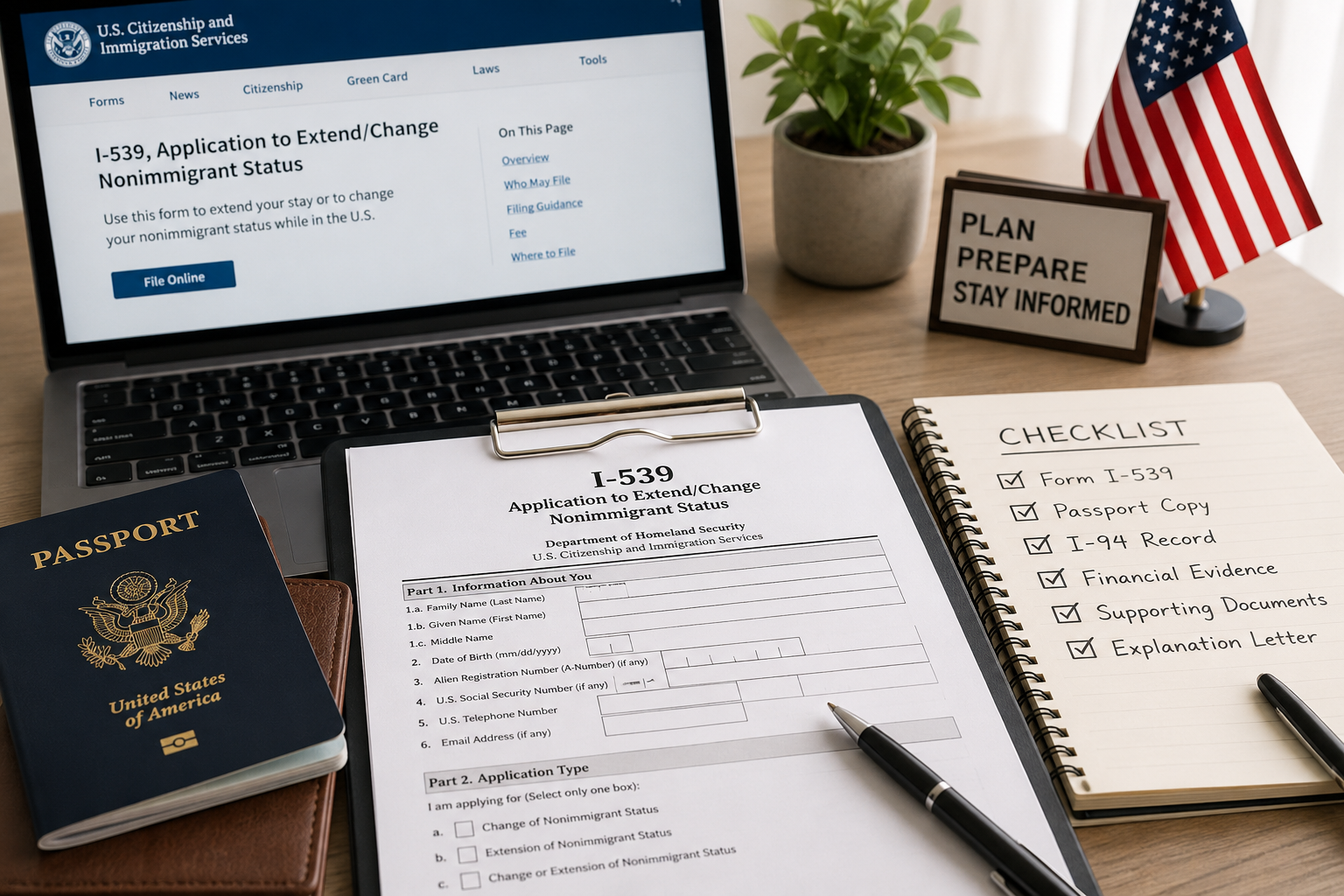
What Is Form I-539?
Form I-539, Application to Extend/Change Nonimmigrant Status, is a USCIS form used by certain people in the United States who want to extend their stay or change to another nonimmigrant status. USCIS also provides online filing eligibility guidance for some applicants who meet the conditions to file Form I-539 online.
This form is commonly connected to change of status or extension of stay requests. However, it is not used for every immigration situation. Some categories require a different process.
Before filing, applicants should carefully check whether Form I-539 is the correct form for their situation.
Who May Use Form I-539?
Form I-539 may be used by certain nonimmigrants who want to:
- Extend their stay in the same status
- Change from one nonimmigrant status to another
- Apply for certain dependent statuses
- Request certain student or visitor-related changes
The exact eligibility depends on the person’s current status and requested status.
Some employment-based changes may require a petition from an employer instead of Form I-539. Because of this, applicants should not assume that Form I-539 is always the right form.
Basic Form I-539 Checklist
Before starting Form I-539, prepare the basic information and documents that may be needed.
A general checklist may include:
- Valid passport
- Current U.S. visa copy, if available
- Most recent Form I-94
- Current immigration status documents
- Explanation of why you are requesting the change or extension
- Financial support documents, if required
- Documents related to the new requested status
- Marriage certificate or birth certificate for dependents, if needed
- USCIS filing fee information
- Mailing address or online filing account information
This is not a complete list for every case. The required documents depend on the status you have now and the status you are requesting.
Check Your I-94 Before Filing
One of the most important steps is checking your Form I-94.
Your I-94 shows how long you are allowed to stay in the United States. Many people look only at the visa expiration date in the passport, but the I-94 date is often more important for your authorized stay.
Before filing Form I-539, check:
- Your name and passport information
- Your admission class
- Your most recent entry date
- Your “Admit Until Date”
- Whether the I-94 says D/S
If the information is wrong or your stay is close to expiring, you should review your options carefully.
Write a Clear Explanation Letter
Many applicants include a written explanation with their Form I-539 package.
The letter should be simple, honest, and organized. It may explain:
- Your current status
- What status you are requesting
- Why you are requesting the change or extension
- How you will support yourself financially
- Your plans after the requested period
- Any important facts USCIS should understand
The letter should not exaggerate or promise things that are not true. A clear and truthful explanation is usually better than a long and confusing letter.
Prepare Financial Documents
Depending on the requested status, USCIS may want to see that you can support yourself during your stay.
Financial documents may include:
- Bank statements
- Sponsor letter
- Sponsor’s proof of income
- School financial documents
- Scholarship or funding letter
- Proof of payment for school or program fees, if applicable
The type of financial evidence depends on the case. A student case may need different documents than a visitor extension or dependent status case.
Do Not Start the New Activity Too Early
One common mistake is assuming that filing Form I-539 gives permission to begin the new activity right away.
In many cases, filing does not automatically allow the applicant to start studying, working, or doing something that requires the new status. The person may need to wait until USCIS approves the request.
This is especially important for students and workers. Starting too early may create immigration problems.
Online Filing vs. Paper Filing
Some applicants may be eligible to file Form I-539 online. USCIS states that online filing may be available for applicants who meet certain conditions.
However, not everyone can file online. Some applicants may need to file by mail, depending on their category, documents, or filing situation.
Before filing, check the current USCIS instructions and filing address information. USCIS filing rules and addresses can change.
Common Mistakes on Form I-539
Here are common mistakes to avoid:
- Filing the wrong form
- Missing the I-94 document
- Waiting until the last minute
- Giving incomplete address history
- Forgetting to sign the form
- Using outdated fee information
- Not including dependent documents
- Sending the application to the wrong filing location
- Assuming online filing is available for every case
Small mistakes can cause delays, rejection, or requests for more evidence.
After Filing Form I-539
After filing, USCIS may send a receipt notice. The receipt notice confirms that USCIS received the application.
Later, USCIS may:
- Approve the application
- Deny the application
- Ask for more evidence
- Request additional steps, depending on the case
Applicants should keep copies of everything submitted and track their case using the USCIS receipt number.
FAQ
Does Form I-539 guarantee approval?
No. Filing Form I-539 does not guarantee approval. USCIS reviews the application and decides based on the facts, eligibility, and supporting documents.
Can I file Form I-539 after my I-94 expires?
Filing after the I-94 expires can be risky and may limit your options. In general, applicants should try to file before their authorized stay expires.
Can I include my family members?
In some situations, certain family members may be included or may need related filings. The rules depend on the visa category and the family relationship.
Should I use online filing?
Online filing may be available for some applicants, but not all. Check the USCIS online filing eligibility page before choosing the filing method.
Final Reminder
Form I-539 can be an important form for people who need to extend or change nonimmigrant status in the United States. But the process depends on your current status, your requested status, your I-94, and your supporting documents.
Before filing, review the official USCIS instructions, prepare your documents carefully, and consider getting help from a qualified immigration professional if your case is complicated.