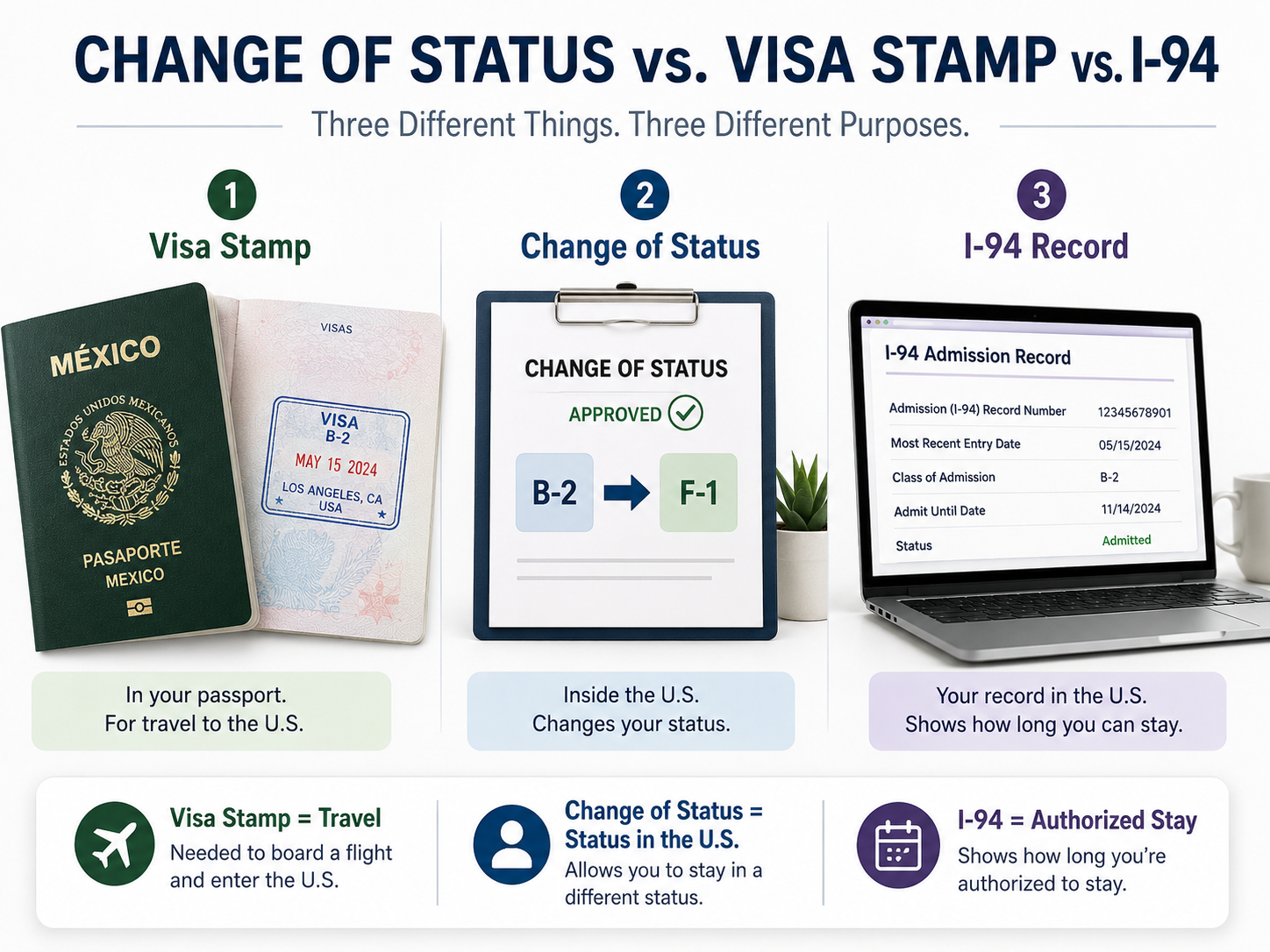
When people talk about changing their visa status in the United States, they often mix up three different things: visa stamp, status, and I-94.
These words are connected, but they do not mean the same thing. Understanding the difference can help you avoid confusion about how long you may stay in the U.S., what happens if you travel, and what a change of status approval really means.
This article explains the difference in simple terms. It is general information only, not legal advice. Always check official USCIS, CBP, or Department of State instructions for your specific case.
What Is a Visa Stamp?
A visa stamp is the visa placed in your passport by a U.S. embassy or consulate outside the United States.
In simple terms, a visa stamp usually allows you to travel to a U.S. port of entry and ask for admission. It does not automatically decide how long you can stay inside the United States.
For example, your B-1/B-2 visa stamp may be valid for several years. But each time you enter the U.S., the officer may admit you for a specific period of stay. That period is usually shown on your I-94.
What Is U.S. Status?
Your status is your legal classification while you are inside the United States.
Examples of nonimmigrant status may include:
- B-1/B-2 visitor
- F-1 student
- J-1 exchange visitor
- H-1B worker
- H-4 dependent
- L-1 worker
- L-2 dependent
Your status affects what you are allowed to do while you are in the U.S. For example, a visitor generally has different rules from a student or temporary worker.
When someone says “change of status,” they are usually talking about asking USCIS to change their current nonimmigrant status to another nonimmigrant status while they remain inside the United States.
What Is Form I-94?
Form I-94 is very important because it usually shows your admission class and how long you are authorized to stay in the United States.
This is why checking your I-94 is often more important than checking only the visa stamp in your passport.
Your visa stamp may still be valid, but your I-94 may show a shorter authorized stay. In many cases, the I-94 date is what tells you how long you may remain in the United States.
Change of Status vs. Visa Stamp
Here is the simple difference.
A visa stamp is usually for travel and entry.
A status is your classification while you are inside the United States.
A change of status is a request to USCIS to change your classification while you are already in the United States.
A new visa stamp is usually requested through a U.S. embassy or consulate outside the United States.
This means that if USCIS approves your change of status, your status in the U.S. may change. But that approval does not automatically place a new visa stamp in your passport.
Example: Visitor to Student
Here is a common example.
A person enters the United States as a B-2 visitor. Later, the person decides to study in the U.S. and wants to change to F-1 student status.
If eligible, the person may request a change of status from inside the United States. If USCIS approves the request, the person may receive F-1 status while staying in the U.S.
However, this does not mean the person now has an F-1 visa stamp in the passport. If the person later leaves the U.S., they may need to apply for an F-1 visa at a U.S. embassy or consulate before returning.
This is one of the most common misunderstandings about change of status.
Why This Difference Matters
The difference matters because it can affect your travel plans.
If your change of status is approved inside the U.S., you may be allowed to remain in the U.S. under the new status. But if you travel outside the United States, your next entry may require a valid visa stamp in the correct category.
So, a person should not assume that an approved change of status automatically solves future travel issues.
Can You Stay If Your Visa Stamp Expires?
In many cases, yes, if your authorized period of stay has not expired.
For example, your visa stamp may expire while you are in the United States, but your I-94 or status document may still allow you to remain.
However, if you leave the U.S., you may need a valid visa to return.
This is another reason why the visa stamp and I-94 should not be confused.
Does Change of Status Give You a New Visa?
No. Change of status does not give you a new visa stamp.
USCIS handles many change of status requests inside the United States. U.S. embassies and consulates generally handle visa applications outside the United States.
So, an approved change of status may change your status while you are in the U.S., but it does not create a new visa stamp in your passport.
This is why people sometimes have valid status in the United States but do not have a valid visa stamp for international travel.
What Happens If You Leave the U.S.?
If you leave the United States after changing status, you may need to apply for a visa in the new category before returning.
For example, if you changed from B-2 visitor status to F-1 student status inside the U.S., you may need an F-1 visa stamp to return after international travel.
Your exact situation depends on your status, visa category, travel plans, and whether any special rules apply. Before traveling, check the latest official instructions or speak with a qualified immigration attorney if you are unsure.
Change of Status Is Not Adjustment of Status
Change of status and adjustment of status are also different.
Change of status usually means changing from one nonimmigrant status to another nonimmigrant status.
Adjustment of status usually means applying for lawful permanent resident status, also known as a green card, from inside the United States.
Because the names sound similar, many people confuse them. But they are different immigration processes.
Simple Comparison Table
| Term | What It Means | Who Usually Handles It |
|---|---|---|
| Visa stamp | Travel document in your passport | U.S. embassy or consulate |
| Status | Your legal classification inside the U.S. | DHS/USCIS/CBP depending on the situation |
| I-94 | Record showing admission class and authorized stay | CBP |
| Change of status | Request to change nonimmigrant status inside the U.S. | USCIS |
| Adjustment of status | Green card process from inside the U.S. | USCIS |
Common Misunderstandings
Many applicants make mistakes because they use the words “visa” and “status” as if they mean the same thing.
Common misunderstandings include:
- Thinking a visa expiration date controls the full U.S. stay
- Thinking an approved change of status gives a new visa stamp
- Thinking a valid visa always means the person can stay until the visa expires
- Thinking an expired visa always means the person is out of status
- Thinking change of status and adjustment of status are the same process
These misunderstandings can cause serious problems, especially when planning travel or future applications.
FAQ
Is my visa the same as my status?
No. Your visa is usually used for travel to the United States. Your status is your classification while you are inside the United States.
If USCIS approves my change of status, do I get a new visa stamp?
No. A change of status approval does not place a new visa stamp in your passport.
Can I stay in the U.S. after my visa stamp expires?
In many cases, you may remain in the U.S. during your authorized period of stay, even if your visa stamp expires. You should check your I-94 and status documents, not only the visa stamp.
What should I check before traveling after change of status?
You should check whether you need a valid visa stamp in the new category before returning to the United States. You should also review your status documents and official embassy or consulate instructions.
Is change of status the same as getting a green card?
No. Change of status usually means changing from one temporary nonimmigrant status to another. A green card process from inside the U.S. is usually called adjustment of status.
Final Reminder
Change of status, visa stamp, and I-94 are different but connected.
A visa stamp usually helps you travel to the United States. Your status controls your classification while you are inside the U.S. Your I-94 usually shows your authorized stay. A change of status approval may change your status inside the United States, but it does not automatically give you a new visa stamp.
Before filing, traveling, or making plans based on your status, check official instructions and get professional help if your situation is complicated.