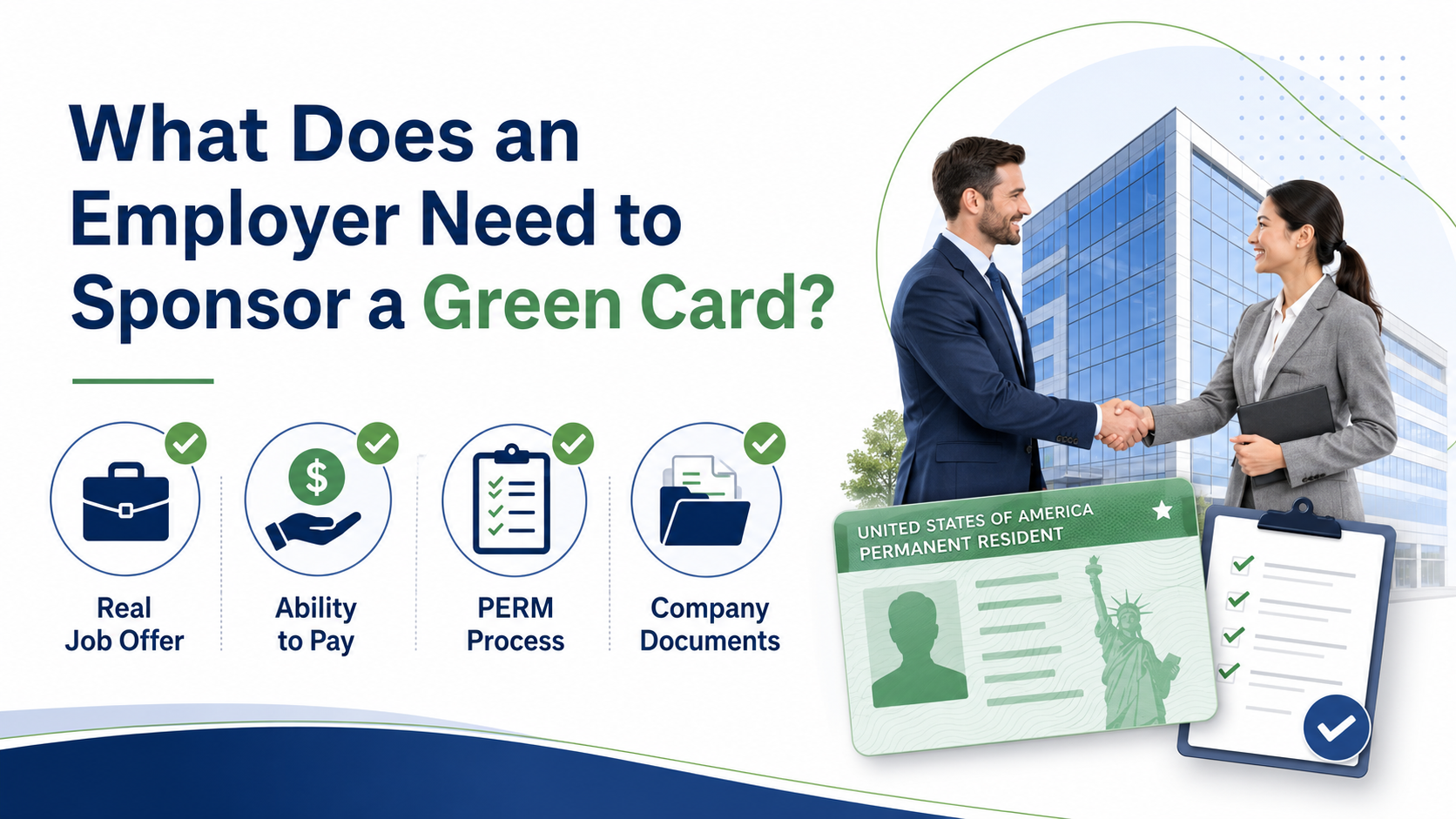
Many workers in the United States wonder whether their employer can help them get a green card.
A common question is:
“Can my company sponsor me?”
The answer depends on the type of green card case, the job position, the employer’s ability to support the case, and whether the required immigration steps can be completed.
In many employment-based green card cases, the employer plays an important role. The employer may need to offer a permanent full-time job, go through the PERM labor certification process, show that the job is real, and prove that the company can pay the required wage.
This guide explains the basic employer-side requirements in a simple way.
Can Any Employer Sponsor a Green Card?
In general, a U.S. employer may be able to sponsor a foreign worker for an employment-based green card if the employer has a real job opportunity and can meet the required immigration and labor certification rules.
The employer does not always have to be a large company. Small businesses can also sponsor workers. However, the employer must be able to provide proper documents and show that the job offer is legitimate.
The key question is not only whether the employer wants to sponsor the worker. The important question is whether the employer can support the case with the right job, wage, business documents, and process.
The Employer Must Have a Real Job Offer
For many employment-based green card cases, the employer must offer a real position.
This means the job should not be created only for immigration purposes. The company should have a genuine business need for the position.
The job offer should usually include:
- a real job title
- actual job duties
- a work location
- required education or experience
- a wage offer
- a long-term employment intention
The job duties should match what the employee will actually do. If the job description is too vague, too exaggerated, or very different from the company’s real business, it may create problems.
The Employer Must Be Able to Pay the Required Wage
One important part of an employer-sponsored green card case is the employer’s ability to pay the offered wage.
In many cases, the required wage is connected to the prevailing wage. The prevailing wage is generally based on the job duties, job requirements, work location, and occupation classification.
The employer may need to provide financial documents to show that it can pay the offered wage. Depending on the case, documents may include tax returns, financial statements, annual reports, payroll records, or other business records.
This is one reason why company documents matter. Even if the employer is willing to sponsor the worker, the case may be difficult if the company cannot show enough financial ability.
The Employer May Need to Complete the PERM Process
Many EB-2 and EB-3 green card cases require a process called PERM labor certification.
PERM is handled by the U.S. Department of Labor. According to the Department of Labor, a permanent labor certification allows an employer to hire a foreign worker permanently in the United States, and in most cases the employer must obtain a certified labor certification before filing the immigrant petition with USCIS. The Department of Labor also explains that it must certify there are not sufficient U.S. workers who are able, willing, qualified, and available for the job, and that hiring the foreign worker will not negatively affect wages and working conditions of similarly employed U.S. workers.
The PERM process usually involves several steps, including:
- identifying a permanent full-time job opportunity
- determining the job duties and minimum requirements
- requesting a prevailing wage determination
- completing required recruitment steps
- filing the PERM application
The Department of Labor notes that employers must have a valid Federal Employer Identification Number, a U.S. location where workers may be referred, and a prevailing wage determination before filing a PERM application.
Job Duties and Requirements Must Be Reasonable
The employer cannot simply choose any job title or requirements.
The job duties and minimum requirements should be reasonable for the position. For example, if a job normally does not require a master’s degree, but the employer adds a master’s degree requirement without a clear business reason, that may raise questions.
The job requirements should match the actual needs of the company and the position.
This is where job title, job duties, education, experience, and wage all connect.
A job title alone is not enough. Immigration and labor agencies look at what the worker will actually do.
Small Companies Can Sponsor, But Documentation Matters
A small company can sponsor a green card, but documentation becomes especially important.
A small business may need to show:
- the company is active and operating
- the job is real
- the company has a real need for the position
- the company can pay the offered wage
- the business has proper tax or financial records
- the job duties make sense for the company
A small company does not automatically mean the case is weak. However, if the company has little revenue, few employees, unclear business activity, or incomplete records, the case may need careful review before starting.
Does the Employer Have to Pay All Costs?
Some costs in employment-based green card cases may be the employer’s responsibility, especially in PERM-related cases. The rules can be different depending on the step, the type of cost, and the case structure.
Workers and employers should be careful about fee arrangements. Before starting, both sides should clearly understand who is responsible for which costs and whether any payment arrangement is allowed.
This is something that should be reviewed carefully with a qualified immigration attorney or legal professional.
What Should Workers Ask Before Starting?
If you are hoping your employer will sponsor your green card, it may help to ask practical questions first.
For example:
- Is the employer willing to sponsor a green card?
- Is the job permanent and full-time?
- What is the job title?
- What are the actual job duties?
- What education or experience does the job require?
- Can the employer provide tax or financial documents?
- Is the employer willing to cooperate with the PERM process if required?
- Has the employer sponsored workers before?
These questions can help avoid confusion before the case begins.
What If the Employer Is a Family Business?
A family business may be able to sponsor a green card, but these cases can be reviewed more carefully.
If the worker has a close family relationship with the owner, immigration or labor agencies may look closely at whether the job offer is real and whether the recruitment process is fair.
This does not always mean the case is impossible. But it does mean the case should be reviewed carefully before filing.
What If the Worker Already Works for the Company?
Many workers are already employed by the company before the green card process begins.
That does not automatically prevent sponsorship. However, the green card case still needs to be based on a proper permanent job offer and the correct process.
The employer may still need to show the job duties, required qualifications, wage, ability to pay, and other documents.
General Reminder
An employer-sponsored green card case is not only about the employee’s qualifications. The employer also matters.
The employer should have a real job offer, a legitimate business need, the ability to pay the required wage, and the willingness to complete the necessary process.
For many workers, the first step is not filing a form. The first step is understanding whether the employer and the job position are strong enough to support the case.
Employment-based green card rules can vary depending on the visa category, job position, employer, country of chargeability, and the worker’s immigration history. This article is for general information only and is not legal advice. Always review your specific situation with a qualified immigration attorney or legal professional before starting a green card case.