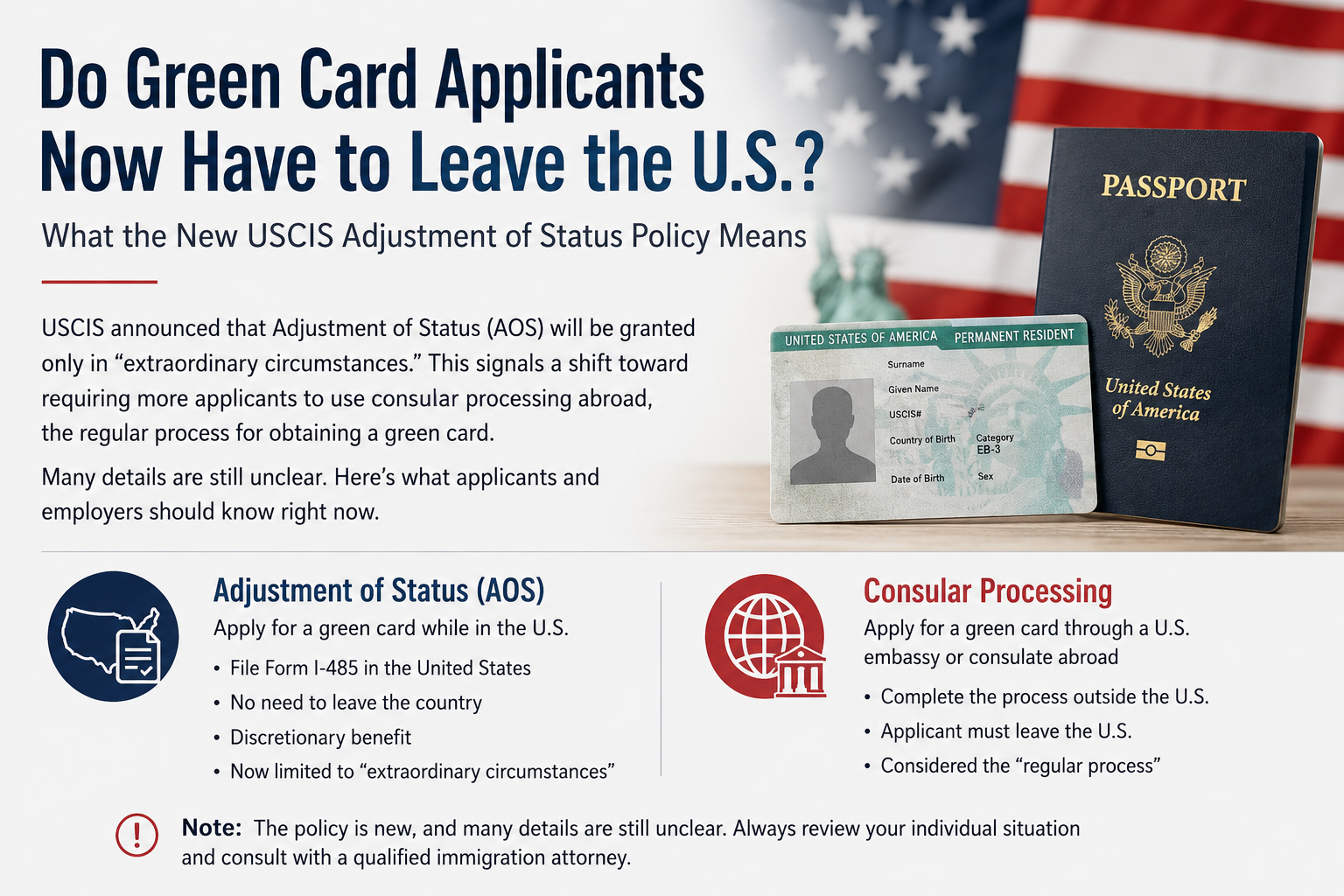
A recent USCIS policy announcement has raised a serious question for many immigrants, employees, and employers:
Do green card applicants now have to leave the United States and apply from their home country?
The answer is not simple. Current reports say USCIS is moving toward a much stricter approach to Adjustment of Status, the process that allows certain green card applicants to apply from inside the United States. USCIS has described Adjustment of Status as a discretionary benefit that may be granted only in extraordinary circumstances, while consular processing abroad is being emphasized as the regular process.
However, many details are still unclear. This article explains what is currently known, what remains uncertain, and what applicants and employers should consider.
What Is Adjustment of Status?
Adjustment of Status, often called AOS, is the process that allows some people already in the United States to apply for a green card without leaving the country.
For many applicants, this is done by filing Form I-485, Application to Register Permanent Residence or Adjust Status.
For example, a worker may be in the United States in a temporary work visa status and later become eligible for an employment-based green card. If the person qualifies, they may have planned to file Form I-485 and wait for the green card decision while staying in the United States.
The recent USCIS policy announcement has created concern because it suggests that this in-country process may be treated more narrowly going forward.
What Did USCIS Announce?
USCIS announced that it will grant Adjustment of Status only in extraordinary circumstances. The agency’s policy materials emphasize that Adjustment of Status is discretionary and that consular immigrant visa processing abroad is the regular path for obtaining permanent residence.
News reports described the announcement as a major change that may require many foreign nationals who are currently in the United States to return to their home countries to apply for green cards through a U.S. consulate. Reuters reported that USCIS told foreigners seeking green cards to return to their countries to apply, while AP reported that the administration is moving to require many foreigners in the United States to apply abroad.
At the same time, the exact implementation details are still not fully clear. Applicants should not assume that every green card case will be treated the same way.
Does This Mean All Green Card Applicants Must Leave the U.S.?
Not necessarily.
The announcement does not mean that every person with a green card case must immediately leave the United States. It also does not mean that every pending immigration case is automatically denied.
What it does mean is that applicants should be more cautious about assuming they can complete the green card process through Adjustment of Status inside the United States.
The biggest unanswered questions include:
- How USCIS will define “extraordinary circumstances”
- Whether the policy will apply differently to family-based and employment-based cases
- How pending I-485 applications will be treated
- Whether some visa categories will be treated more favorably than others
- Whether lawsuits will delay, limit, or change the policy
- Whether USCIS will issue more detailed instructions
Because of these uncertainties, applicants should avoid making travel, work, or immigration decisions based only on headlines.
What Is Consular Processing?
Consular Processing is the process of applying for an immigrant visa through a U.S. embassy or consulate outside the United States.
For many applicants, this means the case goes through the National Visa Center, also known as NVC, and the applicant later attends an immigrant visa interview at a U.S. embassy or consulate abroad.
For example, a Korean applicant may need to attend an immigrant visa interview at the U.S. Embassy in Seoul. If the immigrant visa is approved, the applicant uses that visa to enter the United States as a lawful permanent resident.
This is different from Adjustment of Status because the applicant must complete the final stage outside the United States.
Why This Matters for Workers and Employers
This policy announcement is especially important for employers sponsoring foreign workers for employment-based green cards.
Many employment-based green card cases begin with:
- Prevailing Wage Determination
- Recruitment
- PERM labor certification
- Form I-140 immigrant petition
- Final green card processing
The recent announcement does not appear to stop employers from beginning the PERM process. The main issue is the final stage: whether the employee can file Form I-485 in the United States or must complete consular processing abroad.
This distinction matters because a worker who must leave the United States for consular processing may face a work interruption.
Can Employers Still Start the PERM Green Card Process?
Based on the information currently available, yes.
The USCIS announcement is focused on Adjustment of Status, not the earlier Department of Labor PERM steps. Employers may still be able to begin the prevailing wage and PERM process for eligible employees.
However, employers should be careful not to promise that every employee will be able to complete the final stage through Form I-485 inside the United States.
A safer approach is to continue the early green card process while preserving both possible final-stage strategies:
Adjustment of Status, if available and appropriate; or
Consular Processing, if required or safer.
Why E-2 Visa Employees Need Extra Caution
This issue is especially important for employees working in the United States in E-2 status.
E-2 employees may be working for a treaty investor company or an E-2 registered employer. Some employers may later decide to sponsor those employees for employment-based green cards through PERM.
The green card process can still begin, but E-2 employees should be careful because E-2 is not usually treated the same way as H-1B or L-1 for immigrant intent purposes.
H-1B and L-1 visas are generally considered dual-intent classifications. E-2 status is more sensitive because the employee may need to continue showing that they qualify for E-2 status while the green card process is pending.
For E-2 employees, employers should review:
- Current E-2 visa validity
- Most recent I-94 expiration date
- Passport expiration date
- Current job title and worksite
- Actual job duties
- Family members’ status
- Travel plans
- Prior visa refusals or 221(g) history
- Any possible status violation
- Any unauthorized employment concern
- Whether consular processing would cause a serious work interruption
The green card process should not be treated as a replacement for maintaining valid E-2 status.
How Long Could an Employee Be Outside the U.S. for Consular Processing?
If an employee must complete the final green card stage through consular processing, the employee may need to leave the United States and attend an immigrant visa interview abroad.
The interview itself may take only one day, but the total time outside the United States can be longer.
In a smooth case, the employee may need approximately 2 to 4 weeks outside the United States for the medical exam, interview, visa issuance, passport return, and travel back to the United States.
A more conservative estimate may be 1 to 2 months, especially if the employee needs to coordinate medical exam appointments, embassy scheduling, passport delivery, and work travel.
If the case is placed in 221(g) administrative processing, the delay can be much longer. In some cases, the employee may be unable to return to the United States for several weeks or months.
For employers, this possible work interruption should be considered early, especially for employees assigned to active U.S. projects.
What Is Still Unclear?
Several important points are not yet clear.
USCIS has not yet provided enough practical detail to answer every situation. Current reports indicate a major shift toward consular processing, but applicants and employers still need more guidance on how the policy will be applied in real cases.
Unclear issues include:
- The exact meaning of “extraordinary circumstances”
- How employment-based green card applicants will be treated
- Whether E-2 employees will face stricter review than H-1B or L-1 workers
- Whether pending I-485 applications will continue normally
- Whether there will be transition rules
- Whether litigation will affect implementation
- Whether USCIS will issue more detailed category-specific guidance
Because these questions remain open, applicants should not assume that the policy will apply the same way to every case.
What Applicants Should Do Now
Applicants who are already in the green card process should not panic, but they should review their situation carefully.
Important steps include:
- Check your current immigration status
- Review your I-94 expiration date
- Avoid unauthorized employment
- Avoid unnecessary international travel without legal advice
- Keep copies of immigration records
- Discuss whether Adjustment of Status or Consular Processing is safer
- Do not assume that a pending green card case protects your current status
Applicants should also understand that filing a green card case does not automatically give permission to stay or work in the United States unless they have a valid status or separate work authorization.
If you need guidance about your immigration situation, you may consult with an immigration attorney before making important decisions about travel, work, or Adjustment of Status.
What Employers Should Do Now
Employers sponsoring foreign workers should continue planning carefully.
If the company is still at the early PERM stage, the process may still move forward. However, the company should prepare for the possibility that some employees may need to complete the final step through consular processing abroad.
Employers should:
- Review each employee’s current visa status
- Track I-94 expiration dates
- Review job duties and worksites
- Identify employees who may need visa renewals
- Prepare for possible travel or work interruption
- Avoid promising that Form I-485 will definitely be available
- Keep both Adjustment of Status and Consular Processing as possible strategies
For companies with multiple E-2 employees, individual screening is especially important before the case reaches the final green card stage.
Key Takeaway
The recent USCIS announcement does not appear to stop employers from starting the PERM process or prevent all green card cases from moving forward. However, it may significantly affect how some applicants complete the final stage of the green card process.
The main issue is whether an applicant can apply for a green card through Adjustment of Status inside the United States, or whether the applicant must leave the United States and complete consular processing abroad.
Until USCIS provides more detailed guidance, applicants and employers should proceed carefully, maintain valid immigration status whenever possible, and review each case individually before deciding on the final green card strategy.