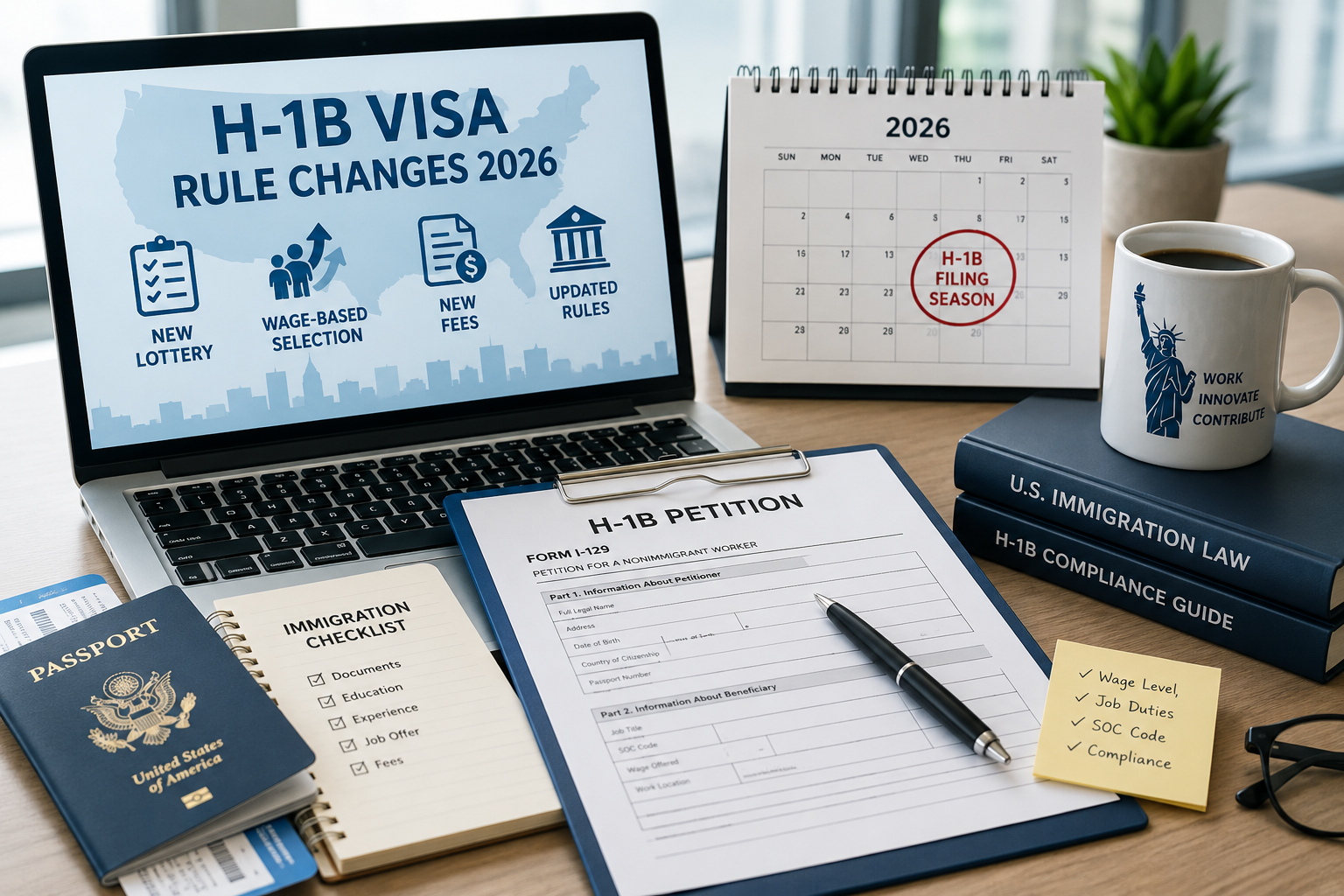
The H-1B visa rule changes are important for workers, students, employers, and anyone planning to apply for a U.S. work visa. In recent years, the U.S. government has updated several parts of the H-1B process, including the lottery selection system, filing requirements, F-1 student protections, employer compliance rules, and petition review standards.
This article explains the main H-1B changes in simple terms. It is for general information only and is not legal advice. H-1B rules can change, and each case may depend on the job, employer, worker’s education, wage level, location, and filing history. Applicants and employers should always check current USCIS instructions or speak with a qualified immigration attorney when needed.
What Is the H-1B Visa?
The H-1B visa allows U.S. employers to hire foreign workers in specialty occupations. A specialty occupation is generally a job that requires specialized knowledge and at least a bachelor’s degree or equivalent in a related field.
Common H-1B fields include:
- Information technology
- Engineering
- Finance
- Data science
- Healthcare-related professional roles
- Architecture
- Education
- Business and research positions
The H-1B is employer-sponsored. This means the worker usually cannot apply alone. A U.S. employer must file the petition with USCIS.
Why Did the H-1B Rules Change?
The government stated that the recent H-1B updates were designed to modernize the program, improve efficiency, add flexibility, and strengthen program integrity. DHS finalized major H-1B modernization changes that became effective on January 17, 2025. Those changes apply to H-1B petitions filed on or after that date.
In 2026, another major change affects the H-1B cap selection process. DHS finalized a weighted selection rule that generally gives higher selection weight to registrations connected to higher wage levels, while still keeping some opportunity for all wage levels. This rule became effective on February 27, 2026, for the FY 2027 H-1B cap season.
Main H-1B Rule Changes in 2026
The H-1B changes can be grouped into several main areas:
- A new weighted selection process for cap-subject H-1B registrations
- Updated specialty occupation standards
- More attention to whether the degree is directly related to the job
- Better cap-gap protection for some F-1 students
- More USCIS authority for site visits and compliance review
- Updated Form I-129 filing requirements
- A new $100,000 payment requirement for certain new H-1B petitions
- More focus on bona fide job offers and accurate registration information
Each change is explained below.
1. New Weighted H-1B Selection Process
One of the biggest changes is the new weighted selection process for H-1B cap registrations.
In the past, the H-1B lottery was mostly random after USCIS received enough registrations to exceed the annual cap. Under the newer weighted selection rule, USCIS still uses a selection process, but registrations are generally weighted based on wage level.
The goal is to give a higher chance of selection to jobs with higher wage levels. DHS explained that the rule is intended to generally favor higher-skilled and higher-paid workers, while still allowing employers to submit registrations for workers at all wage levels.
What does this mean in simple terms?
If two H-1B registrations are both valid, but one job is offered at a higher wage level, the higher wage-level registration may have a better chance of selection than a lower wage-level registration.
This does not mean lower wage-level jobs are automatically disqualified. It means the selection chance may be different depending on the wage level.
Who is affected?
This change mainly affects:
- H-1B cap-subject applicants
- Employers filing H-1B registrations
- F-1 students trying to move from OPT or STEM OPT to H-1B
- Entry-level workers
- Employers offering jobs at lower wage levels
- Employers offering higher-paid professional roles
This rule does not affect every H-1B case in the same way. For example, some H-1B employers may be cap-exempt, such as certain universities, nonprofit research organizations, or government research organizations.
2. H-1B Lottery Is Not Completely Gone
A common misunderstanding is that the H-1B lottery has disappeared. That is not correct.
The new system still includes a selection process when there are more registrations than available H-1B numbers. However, the selection is no longer treated the same way as a purely random process for all wage levels.
Under the final rule, DHS said the process will weight and select unique beneficiaries generally based on the highest OEWS wage level that the offered wage equals or exceeds for the relevant occupation and work location.
In simple terms, wage level now matters more during selection.
3. Higher Wage Levels May Have a Better Chance
DHS estimated that, under the weighted process, selection chances would increase for higher wage levels and decrease for Level I compared with the previous random selection process. The final rule discusses estimated chances of over 45% for Level III and over 61% for Level IV, compared with just under 30% under the prior system.
This is important for employers and workers because wage strategy, job classification, SOC code, and work location may become more important during H-1B planning.
However, employers should not simply increase a wage number without proper support. The offered wage, job duties, SOC code, worksite location, Labor Condition Application, and petition documents should all be consistent.
4. The Job Offer Must Be Real and Accurate
The newer H-1B rules place more attention on whether the registration is connected to a real job offer.
DHS clarified that a valid H-1B registration must represent a bona fide job offer. The H-1B petition filed after selection should contain and be supported by the same identifying information and position information, including SOC code, that was provided in the selected registration and reflected in the supporting LCA.
This means employers should be careful when preparing the registration.
They should avoid:
- Guessing the wrong SOC code
- Listing an inaccurate wage level
- Changing important job details after selection
- Filing a registration without a real job offer
- Using inconsistent information between the registration, LCA, and Form I-129
For workers, this means the employer’s preparation matters a lot. A selected registration does not guarantee H-1B approval.
5. Specialty Occupation Rules Are Clarified
Another major H-1B modernization update involves the specialty occupation requirement.
The H-1B job must generally require a degree in a specific specialty, or an equivalent combination of education, training, and experience. The final rule clarifies how USCIS looks at whether the required degree is directly related to the job duties.
This does not mean every job must require only one exact degree title. In many cases, a job may allow a range of related degree fields. But the employer should be able to explain how each acceptable degree field is directly related to the job duties.
For example, a software engineer position may reasonably accept degrees such as computer science, software engineering, or a closely related field. But if an employer lists many unrelated degrees, USCIS may question whether the job truly requires a specialty occupation.
6. Degree and Job Duties Must Match More Clearly
One practical effect of the H-1B changes is that employers should prepare stronger explanations of the relationship between:
- The job title
- Job duties
- Required degree field
- Worker’s education
- Employer’s business need
- SOC code
- Wage level
- Work location
This is especially important for jobs with broad titles, mixed duties, or general business roles.
For example, a title like “Business Analyst” may need careful explanation. Some business analyst roles may be technical and require a specialized degree. Others may be more general. The petition should clearly explain the actual duties.
7. Cap-Gap Protection for Certain F-1 Students
The H-1B modernization rule also includes a helpful change for some F-1 students.
Cap-gap protection can help certain F-1 students avoid gaps in status or work authorization while waiting for the H-1B change of status process. Under the modernization rule, cap-gap protection may extend to as late as April 1 of the following calendar year in certain cases, instead of ending much earlier under the older framework.
This can be very important for students on OPT or STEM OPT whose employers file H-1B petitions requesting a change of status.
However, not every F-1 student automatically receives cap-gap protection. The timing of the H-1B petition, requested change of status, OPT end date, and USCIS rules all matter.
8. Form I-129 Updates Matter
H-1B petitions are filed using Form I-129, Petition for a Nonimmigrant Worker. USCIS updated Form I-129 in connection with the H-1B modernization rule.
Employers must use the correct edition of the form and follow current USCIS instructions. Filing the wrong form edition, missing required supplements, or using outdated instructions can cause rejection or delays.
This is especially important because H-1B filing windows are time-sensitive. If a selected employer misses the filing window or files incorrectly, the worker may lose the opportunity for that cap season.
9. $100,000 Payment Requirement for Certain New H-1B Petitions
Another major issue is the $100,000 payment requirement connected to certain new H-1B petitions filed after September 21, 2025. USCIS has stated that certain new H-1B petitions filed at or after 12:01 a.m. Eastern on September 21, 2025, must be accompanied by an additional $100,000 payment as a condition of eligibility.
This topic is especially important because it may not apply to every H-1B situation in the same way. Applicants and employers should review the official USCIS guidance carefully before assuming whether the payment applies.
In general, employers should confirm:
- Whether the case is considered a new H-1B petition
- Whether an exception may apply
- Whether the worker is inside or outside the United States
- Whether the petition is cap-subject or cap-exempt
- Whether the filing date triggers the rule
- What evidence of payment or exception must be included
Because this is a major financial issue, employers should not rely only on general summaries. They should check USCIS instructions and get legal guidance if needed.
10. USCIS Site Visits and Compliance Review
The H-1B modernization changes also strengthen program integrity. USCIS may review whether the employer and job are real, whether the worker is doing the listed job, and whether the information in the petition is accurate.
Site visits may involve questions about:
- Work location
- Job duties
- Wage
- Employer operations
- Supervisor information
- Remote work arrangements
- Third-party worksite details
- Whether the H-1B worker is doing the job described in the petition
Employers should keep clear records and make sure the petition matches the actual employment.
11. Third-Party Placement and Remote Work Need Careful Documentation
Many H-1B workers work at client sites, hybrid locations, or remotely. The newer rules do not automatically ban these arrangements, but they may require careful documentation.
Employers should be ready to explain:
- Where the worker will work
- Who supervises the worker
- What the worker will do
- Whether the employer has the right to control the work
- Whether the LCA covers the correct work location
- Whether the job is non-speculative and real
For remote work, employers should also consider whether the home worksite or other remote location affects the LCA and wage requirements.
12. Beneficiary-Owners May Have a Clearer Path
The modernization rule also provides more clarity for some H-1B workers who own part of the petitioning company.
This may help startup founders and entrepreneurs in some situations. However, beneficiary-owner cases can still be complex. USCIS may review whether there is a real job, whether the company is operating, whether the worker will perform specialty occupation duties, and whether the employer-employee relationship requirements are satisfied.
Startup founders should prepare strong business and employment documentation before filing.
13. What H-1B Applicants Should Do Now
H-1B applicants should not wait until the last minute. Even though the employer files the H-1B petition, the worker usually needs to provide documents and information early.
Applicants should prepare:
- Passport information
- Immigration history
- Current visa status documents
- I-94 record
- Degrees and transcripts
- Education evaluations if needed
- Resume
- OPT or STEM OPT documents, if applicable
- Prior approval notices, if any
- Current employment information
- Any dependent family information, if needed
Applicants should also talk with the employer about timing. H-1B registration, selection, LCA preparation, and petition filing all have deadlines.
14. What Employers Should Do Now
Employers should review H-1B planning more carefully under the new rules.
Important steps include:
- Confirm the job is a specialty occupation
- Choose the correct SOC code
- Confirm the correct work location
- Review the wage level
- Make sure the job offer is real and documented
- Prepare the LCA correctly
- Use the correct Form I-129 edition
- Keep the registration, LCA, and petition consistent
- Plan for possible site visits or USCIS questions
- Check whether the $100,000 payment rule applies
Employers should also avoid filing registrations for jobs that are uncertain or not fully planned.
15. Common Mistakes to Avoid
H-1B mistakes can be expensive and difficult to fix. Common mistakes include:
- Assuming selection means approval
- Filing with inconsistent job information
- Using a broad degree requirement without explanation
- Choosing the wrong SOC code
- Listing the wrong work location
- Forgetting remote worksite issues
- Missing the filing deadline
- Using the wrong Form I-129 edition
- Ignoring the $100,000 payment requirement when it applies
- Failing to prepare for USCIS site visits
- Assuming cap-gap protection applies automatically
A careful filing strategy is more important under the updated rules.
16. Does the New Rule Help or Hurt H-1B Applicants?
The answer depends on the case.
The new weighted selection process may help applicants with higher wage-level jobs because their registrations may have a better chance of selection. It may be harder for some entry-level applicants if the job is classified at a lower wage level.
The modernization rule may help some F-1 students through improved cap-gap protection. It may also help some employers and workers by clarifying prior approval deference and certain filing standards.
At the same time, employers may face more compliance responsibilities, more careful documentation requirements, and higher financial risk in cases affected by the $100,000 payment rule.
17. Does a Higher Salary Guarantee H-1B Selection?
No. A higher salary does not guarantee selection.
The new process is weighted, not guaranteed. Higher wage levels may improve the chance of selection, but the process can still include randomness when demand is higher than the available number of H-1B visas.
Also, selection is only the first step. After selection, the employer must still file a complete H-1B petition, and USCIS must approve it.
18. Does H-1B Approval Become Easier?
Not necessarily.
Some parts of the rule may provide clearer standards and more flexibility. But USCIS can still deny a petition if the employer does not prove eligibility.
The employer must still show:
- The job qualifies as a specialty occupation
- The worker is qualified for the job
- The wage and LCA are proper
- The job offer is real
- The employer can comply with H-1B requirements
- The petition documents are accurate and complete
19. H-1B Rule Changes and F-1 Students on OPT
F-1 students on OPT or STEM OPT should pay close attention to these changes.
The weighted selection process may affect students differently depending on the job, wage level, occupation, and location. Some students may benefit if they receive high-wage offers. Others in entry-level positions may face lower selection odds.
Cap-gap protection may help some students remain in status and continue work authorization while the H-1B change of status petition is pending. But students should not assume protection applies without checking their specific dates and filing details.
Students should work closely with their DSO, employer, and immigration counsel when needed.
20. H-1B Rule Changes and Small Employers
Small employers may still use the H-1B program, but they need careful preparation.
A small company should be ready to show:
- It is a real operating business
- It can pay the offered wage
- It has a real need for the specialty occupation role
- The worker will perform the stated job duties
- The company can supervise the worker
- The job is not speculative
Small employers should also consider the financial impact of filing fees, attorney fees, wage obligations, and any applicable additional payment requirements.
Frequently Asked Questions About H-1B Rule Changes
Did the H-1B lottery change in 2026?
Yes. For the FY 2027 H-1B cap season, DHS implemented a weighted selection process that generally gives more selection weight to higher wage levels while still allowing registrations at all wage levels.
Is the H-1B lottery now based only on salary?
Not exactly. The process generally uses wage levels connected to the offered wage, occupation, and work location. It is not simply based on the highest dollar salary alone.
Can entry-level workers still apply for H-1B?
Yes, entry-level workers may still be registered for H-1B. However, under the weighted selection system, lower wage-level registrations may have a lower chance of selection than higher wage-level registrations.
Does H-1B selection mean the visa is approved?
No. Selection only allows the employer to file the full H-1B petition. USCIS must still review and approve the petition.
Did the specialty occupation requirement change?
The rule clarified the specialty occupation standard and the relationship between the required degree and the job duties. Employers should clearly explain why the required degree field is directly related to the position.
Does the $100,000 payment apply to every H-1B case?
Not necessarily. USCIS guidance should be checked carefully because the rule applies to certain new H-1B petitions filed after the stated effective time, and exceptions or case-specific details may matter.
Are F-1 students affected?
Yes. F-1 students may be affected by both the weighted selection process and cap-gap updates. Some students may benefit from extended cap-gap protection, but eligibility depends on the specific case.
Should employers file H-1B registrations without a confirmed job?
No. A registration should be connected to a real job offer. The petition should match the registration, LCA, and job details.
Final Reminder
The H-1B visa rule changes make preparation more important than before. Employers should review job duties, wage level, SOC code, work location, Form I-129 requirements, and compliance responsibilities before filing. Applicants should prepare their documents early and understand that H-1B selection does not guarantee approval.
Because H-1B rules can change and each case is different, applicants and employers should always check the latest USCIS instructions and consider speaking with a qualified immigration attorney for case-specific guidance.