When an employer sponsors a worker for an employment-based green card, the job title is important.
But the job title is not the only thing that matters.
In many employment-based green card cases, the job must be connected to an occupational classification called an SOC code.
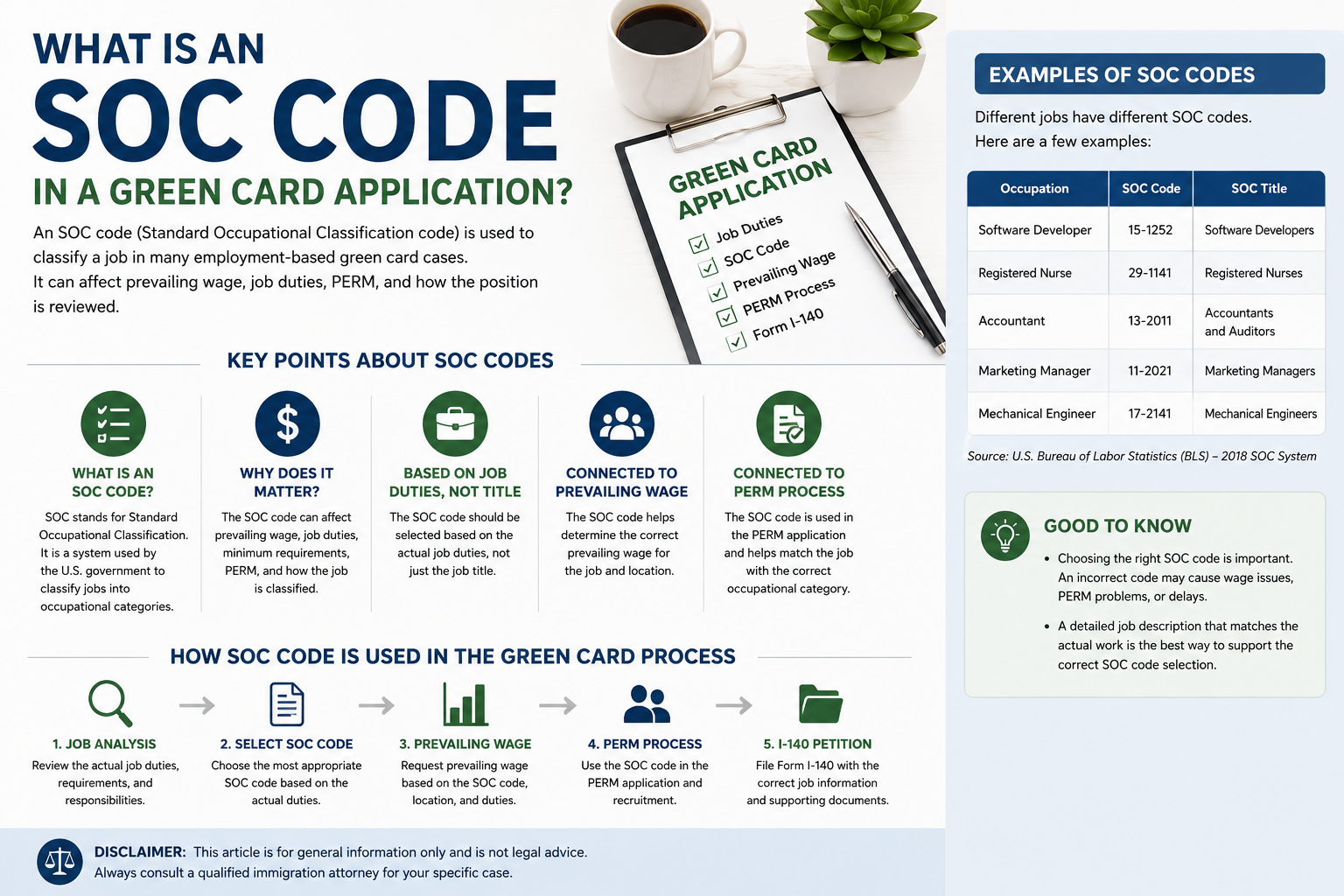
SOC codes can affect the prevailing wage, job duties, PERM process, and how the position is reviewed.
This guide explains what an SOC code is and why it matters in a green card case.
What Is an SOC Code?
SOC stands for Standard Occupational Classification.
The Standard Occupational Classification system is used by U.S. federal agencies to classify workers into occupational categories. The Bureau of Labor Statistics explains that the 2018 SOC system is designed to cover all occupations in which work is performed for pay or profit.
In simple terms, an SOC code is a job classification code.
It helps identify what type of work a position belongs to.
For example, different jobs may fall under different occupational groups, such as:
- computer occupations
- engineering occupations
- management occupations
- office and administrative support occupations
- production occupations
- installation, maintenance, and repair occupations
- healthcare occupations
In a green card case, the SOC code helps connect the job position to the correct occupational category.
Why Does the SOC Code Matter in a Green Card Case?
The SOC code can matter because it helps determine how the job is classified.
That classification may affect important parts of the case, including:
- the prevailing wage
- the job duties
- the minimum education or experience requirements
- the PERM labor certification process
- how the position is described to the government
The SOC code is not just a random number. It is connected to how the job is understood.
If the job is classified incorrectly, the wage or job requirements may not match the actual position.
Is the SOC Code Based Only on the Job Title?
No.
This is one of the most important points.
An SOC code should not be chosen only because the job title sounds similar.
The actual job duties matter more.
For example, two employees may both have the title “manager,” but their real work may be very different.
One person may manage business operations.
Another person may supervise production workers.
Another person may manage IT systems.
Another person may mainly perform hands-on technical work.
Even if the title sounds similar, the correct occupational classification may be different.
Job Duties Matter More Than the Title
In many cases, the government looks beyond the job title and reviews what the employee will actually do.
The job description should explain the real duties of the position.
A good job description should be specific enough to show:
- what the worker does
- what tools, systems, or processes are used
- what level of responsibility the worker has
- whether the worker supervises others
- whether the job is technical, managerial, professional, or operational
- what education or experience is truly required
If the job duties are too general, it may be harder to choose the correct SOC code.
For example, a title like “specialist,” “coordinator,” “technician,” or “manager” may not be enough by itself.
The actual duties explain what the job really is.
How Is the SOC Code Connected to Prevailing Wage?
In many employer-sponsored green card cases, the employer must request a prevailing wage determination.
The prevailing wage is based on several factors, including the job duties, job requirements, work location, and occupational classification.
The SOC code helps connect the job to the correct wage data.
This is why the SOC code can affect the wage level and the required wage.
If the SOC code does not match the real job, the prevailing wage may also be incorrect.
That can create problems later in the case.
How Is the SOC Code Connected to PERM?
Many EB-2 and EB-3 green card cases require the PERM labor certification process.
The PERM process is handled by the U.S. Department of Labor. The Department of Labor explains that, in most cases, an employer must obtain labor certification before filing an immigrant petition with USCIS, and the process is meant to confirm that there are not sufficient U.S. workers who are able, willing, qualified, and available for the job.
In a PERM case, the job position must be described carefully.
The SOC code can affect how the job is classified, how the prevailing wage is issued, and how the employer prepares the case.
That is why the job duties, minimum requirements, and wage request should be consistent.
Can the Wrong SOC Code Cause Problems?
Yes, it can.
A wrong or poorly matched SOC code may cause confusion or problems in the green card process.
Possible issues may include:
- the prevailing wage does not match the real job
- the job duties appear inconsistent
- the minimum requirements do not fit the occupation
- the employer’s recruitment does not match the actual position
- the case may need correction or review before moving forward
Not every mistake causes a denial, but choosing the right classification from the beginning is important.
It can save time and avoid unnecessary problems.
Example: Same Title, Different SOC Code
Imagine a company uses the job title “Operations Manager.”
That title alone does not tell the full story.
The job could involve:
- managing office operations
- supervising manufacturing workflow
- coordinating logistics
- overseeing construction projects
- managing restaurant operations
- leading technical field teams
Each version may involve different duties, different skills, and a different occupational classification.
That is why the title is only the starting point.
The actual job duties must be reviewed carefully.
Who Chooses the SOC Code?
In many employment-based green card cases, the employer and legal representative review the job duties and select an appropriate occupational classification when preparing the case.
The correct classification should be based on the actual position, not simply on what sounds most favorable.
Sometimes there may be more than one possible code to consider. In that situation, the job duties, minimum requirements, business need, and wage issue should be reviewed carefully.
What Should Workers Know?
If your employer is sponsoring your green card, you may hear about the SOC code during the prevailing wage or PERM stage.
You do not need to memorize the entire SOC system.
But you should understand this basic idea:
Your job title alone does not control the case. Your actual job duties matter.
If the job description is unclear, too broad, or different from what you actually do, it may need to be reviewed before filing.
What Should Employers Know?
Employers should be careful when preparing the job description.
Before starting the green card process, the employer should review:
- the real job duties
- the actual minimum requirements
- the work location
- the wage offered
- the business need for the position
- whether the title matches the actual role
- whether the duties support the selected occupation
A clear and accurate job description can make the process smoother.
General Reminder
An SOC code is only one part of an employment-based green card case, but it can be an important part.
It helps classify the job, connects the position to wage data, and supports the prevailing wage and PERM process.
For applicants, the key point is simple: the job title matters, but the real duties matter more.
Employment-based green card cases can vary depending on the employer, job position, visa category, work location, worker’s background, and immigration history. This article is for general information only and is not legal advice. Always review your specific situation with a qualified immigration attorney or legal professional before starting or filing a green card case.