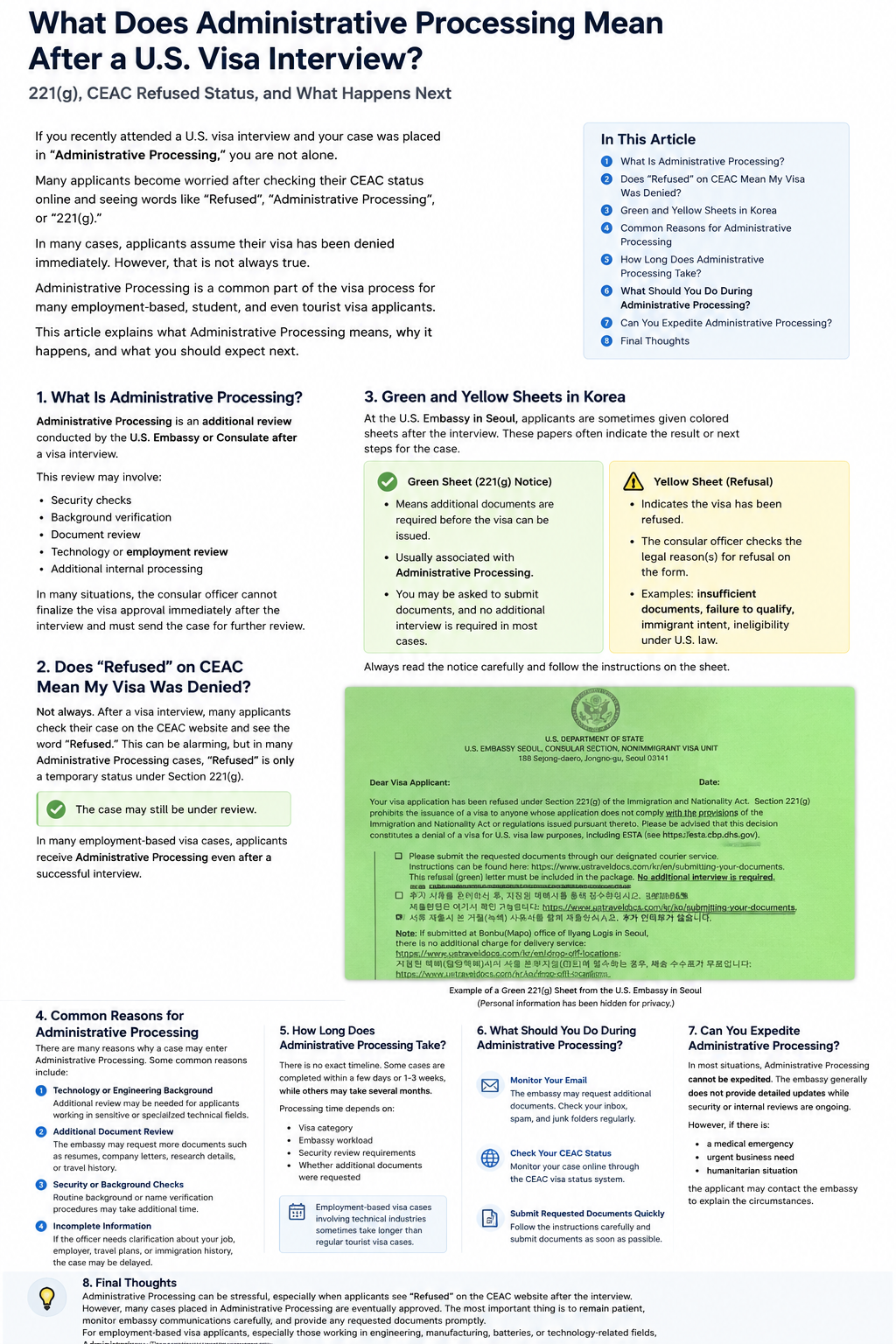
If you recently attended a U.S. visa interview and received a green 221(g) sheet, the consular officer most likely explained that additional documents or further review are required before your visa can be issued.
In many cases, the officer explains why the green sheet is being given and what documents need to be submitted. The sheet itself usually provides instructions for the next step.
However, many applicants still become worried after checking their visa status online through CEAC and seeing words like:
- Refused
- Administrative Processing
- 221(g)
This can be confusing because the applicant was not necessarily told that the visa was permanently denied. Instead, the officer may have explained that the embassy or consulate needs additional documents, additional review, or further processing before making a final decision.
In many approved visa cases, applicants do not receive a green sheet. The officer may simply inform the applicant that the visa has been approved, and the passport is later returned with the visa.
A green 221(g) sheet is usually given when the case is not ready for final issuance yet.
This article explains what Administrative Processing means, why your CEAC status may show “Refused,” what a green 221(g) sheet means, and what you should do next.
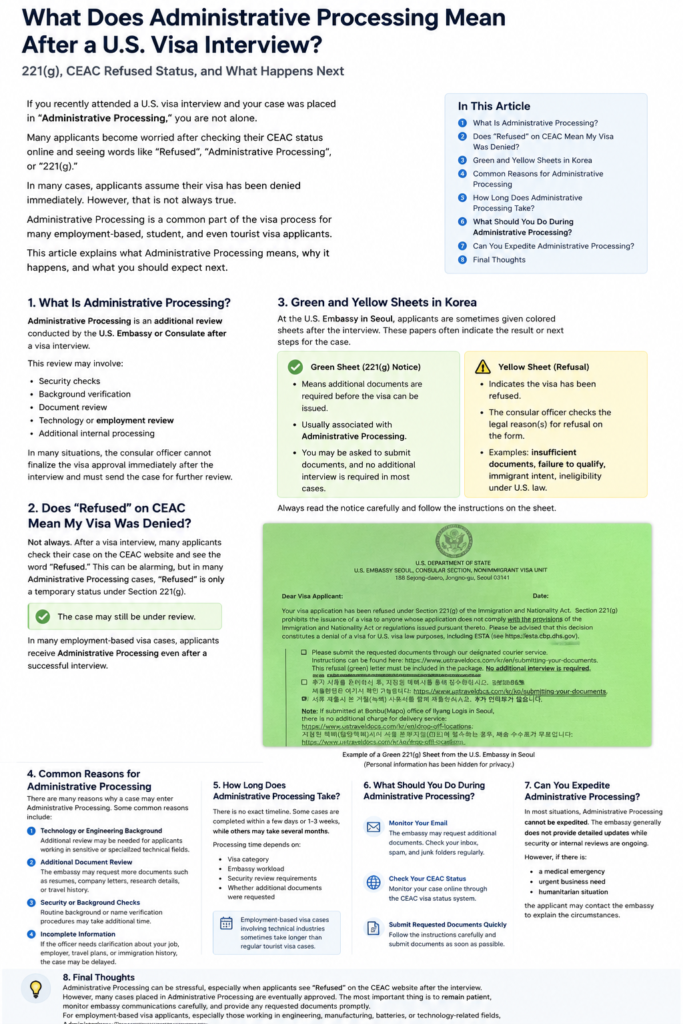
What Is Administrative Processing?
Administrative Processing is an additional review conducted by the U.S. Embassy or Consulate after a visa interview.
This review may involve:
- security checks
- background verification
- document review
- employment or technology-related review
- additional internal processing by the embassy
In many situations, the consular officer cannot issue the visa immediately after the interview. Instead, the officer may place the case into Administrative Processing until the required review is completed.
This does not always mean the visa will be denied. It means the case is not ready for final approval at that moment.
Does “Refused” on CEAC Mean My Visa Was Denied?
Not always.
This is one of the most confusing parts of the visa process.
After a visa interview, some applicants check their case status on the CEAC website and see the word “Refused.” This can be alarming, but in many 221(g) Administrative Processing cases, “Refused” may be a temporary status while the case is still under review.
Under Section 221(g) of the Immigration and Nationality Act, a visa application may be refused temporarily if the officer needs additional documents, additional processing, or further review before the visa can be issued.
In other words, a 221(g) refusal does not always mean the case is permanently denied.
However, applicants should carefully read the notice they receive from the embassy because each case is different.
Green 221(g) Sheet After a U.S. Visa Interview
Applicants may receive a green 221(g) sheet when the consular officer needs additional documents or further review before the visa can be issued.
In many cases, the officer explains at the interview why the green sheet is being given and what the applicant needs to submit. The sheet itself usually includes instructions about the requested documents and how to submit them.
Applicants who are approved at the interview usually do not receive a green sheet. In many approved cases, the officer simply informs the applicant that the visa has been approved, and the passport is later returned with the visa.
A green sheet usually means the case is not ready for final issuance yet. It does not automatically mean the visa has been permanently denied.
The embassy or consulate may request items such as:
- updated resume or CV
- employment verification letter
- company support letter
- company documents
- travel history
- technical or research information
- additional supporting evidence
In many green sheet cases, the notice may state that no additional interview is required. This usually means the applicant only needs to submit the requested documents according to the embassy or consulate’s instructions.
Yellow Sheet After a U.S. Visa Interview
A yellow sheet is different from a green 221(g) sheet.
In many cases, a yellow sheet is associated with a visa refusal or denial. The consular officer may mark or check the specific reason for the refusal on the notice.
This type of notice may be given when the officer determines that the applicant does not qualify for the visa at that time.
Common reasons may include:
- insufficient documentation
- failure to qualify for the requested visa category
- immigrant intent concerns
- prior immigration violations
- prior visa overstays
- criminal or security-related issues
- other ineligibility under U.S. immigration law
Applicants who receive a yellow sheet should carefully review the exact reason marked on the notice. Unlike a green sheet, which often asks for additional documents or further review, a yellow sheet usually means the officer has identified a specific reason why the visa cannot be issued at that time.
However, the next step depends on the specific refusal reason. In some cases, the applicant may be able to reapply later with stronger evidence or corrected information. In other cases, the applicant may need a waiver or legal guidance before applying again.
Because every case is different, applicants should not assume that all yellow sheet refusals have the same solution. The marked reason on the notice is the most important starting point.
Common Reasons for Administrative Processing
There are many reasons why a visa case may be placed into Administrative Processing.
Some of the most common reasons include the following.
1. Technology or Engineering Background
Applicants working in technical industries may be more likely to experience additional review.
This can include fields such as:
- batteries
- semiconductors
- engineering
- advanced manufacturing
- chemical technology
- artificial intelligence
- research and development
For example, employment-based visa applicants who work with battery manufacturing, semiconductor facilities, advanced equipment, or technical production systems may be asked to provide additional information about their job duties or technical background.
The embassy may want to better understand whether the applicant’s work involves sensitive technology or specialized technical knowledge.
2. Additional Document Review
Sometimes the embassy needs more documents before it can continue processing the case.
The applicant may be asked to provide:
- updated resume or CV
- employment verification letter
- company support letter
- detailed job description
- company registration documents
- project information
- travel history
- prior visa information
If the embassy requests documents, the applicant should follow the instructions carefully and submit the documents as soon as possible.
3. Security or Background Checks
Some Administrative Processing cases involve additional security or background checks.
This may happen because of:
- the applicant’s work field
- travel history
- name check issues
- prior immigration history
- government or military-related background
- other internal review requirements
Applicants with common names may also experience delays in some cases because additional verification may be required.
4. Incomplete or Unclear Information at the Interview
Administrative Processing may also happen if the officer needs clarification about the applicant’s case.
For example, the officer may need more information about:
- job duties
- employer information
- purpose of travel
- prior immigration history
- relationship between companies
- source of funds
- business operations in the United States
This is why applicants should prepare clear and consistent answers before the visa interview.
How Long Does Administrative Processing Take?
Unfortunately, there is no exact timeline for Administrative Processing.
Some cases may be completed within a few days or a few weeks. Other cases may take several months.
The timeline depends on many factors, including:
- visa category
- embassy workload
- type of review required
- whether additional documents were requested
- how quickly the applicant responds
- whether security checks are involved
Employment-based visa cases involving technical industries may sometimes take longer than simple visitor visa cases.
Applicants should understand that the embassy usually cannot provide detailed updates while internal review is pending.
What Should You Do During Administrative Processing?
If your case is placed into Administrative Processing, there are several things you should do.
1. Read the Notice Carefully
If you received a green 221(g) sheet or any written notice, read it carefully.
Check whether the embassy is asking for:
- specific documents
- email submission
- courier submission
- passport submission
- no additional interview
- additional instructions
Do not assume every 221(g) case is the same. The instructions on your notice are very important.
2. Check Your Email Regularly
The embassy may contact you by email.
Make sure to check:
- inbox
- spam folder
- junk mail folder
Sometimes applicants miss important embassy emails because the message goes to spam.
3. Submit Requested Documents Quickly and Clearly
If the embassy or consulate asks for additional documents, submit them as soon as possible and follow the instructions on the 221(g) notice carefully.
A delayed or incomplete submission may delay the entire case.
When sending documents by email, applicants should clearly identify their case in the email. The email should usually include:
- full name
- date of birth
- passport number
- visa interview date
- visa category
- case number, if available
Applicants should also attach:
- the requested documents
- a copy of the green 221(g) sheet received after the interview
- a copy of the passport biographic page
Including the green 221(g) sheet helps the embassy or consulate identify what was requested and match the submission to the correct visa case.
If the applicant is represented by an attorney, a properly signed Form G-28 should also be included. This allows the attorney to communicate with the government on behalf of the applicant and may help ensure that the response is properly reviewed.
Before submitting the documents, make sure they are:
- complete
- clear
- accurate
- properly translated, if required
- consistent with the visa application and interview answers
A well-organized and complete response may improve the chance that the case can move forward without unnecessary delay. It does not guarantee approval, but it can help the embassy or consulate review the case more efficiently.
4. Check Your CEAC Status
Applicants can check their visa status through the CEAC website.
You can check your case here:
CEAC Visa Status Check:
https://ceac.state.gov/CEACStatTracker/Status.aspx
The case status may change during processing. However, CEAC updates are not always detailed, and the status may remain the same for a while even if the case is still being reviewed.
Seeing “Refused” during a 221(g) process can be stressful, but it does not always mean the case is permanently denied.
Can You Expedite Administrative Processing?
In most cases, Administrative Processing cannot be expedited.
The embassy usually cannot bypass required internal checks or security reviews.
However, if there is a serious emergency, such as a medical emergency, humanitarian situation, or urgent business need, the applicant may contact the embassy and explain the situation.
Even then, expedite approval is not guaranteed.
When Should You Consider Legal Help?
Applicants may want to consider speaking with an immigration attorney if:
- the case has been pending for a long time
- the embassy requested complicated documents
- the visa was refused for a specific legal reason
- the applicant received a yellow refusal notice
- there are prior immigration violations
- the applicant is unsure how to respond to a 221(g) request
- the case involves a technical or sensitive industry
A careful response can be important, especially when the embassy requests employment, company, or technical documents.
Final Thoughts
Administrative Processing can be stressful, especially when applicants see “Refused” on the CEAC website after the interview.
However, many 221(g) Administrative Processing cases are eventually approved after the embassy completes its review or receives the requested documents.
At the U.S. Embassy in Seoul, a green sheet is usually given when additional documents or further review are required. Applicants who are approved at the interview typically do not receive a green sheet.
The most important steps are to carefully read the embassy notice, monitor your email, submit requested documents promptly, and remain patient while the case is being reviewed.
For employment-based visa applicants, especially those working in engineering, manufacturing, batteries, semiconductors, or other technology-related fields, Administrative Processing is not uncommon.
Disclaimer: This article is for general informational purposes only and does not constitute legal advice. Every visa case is different. Applicants should review their own embassy notice carefully and consult with an immigration attorney if they need legal advice about their specific situation.